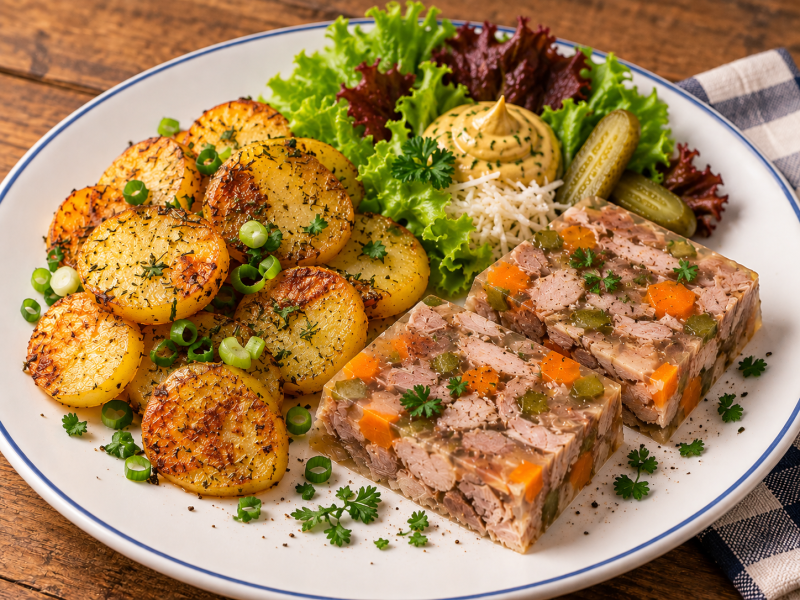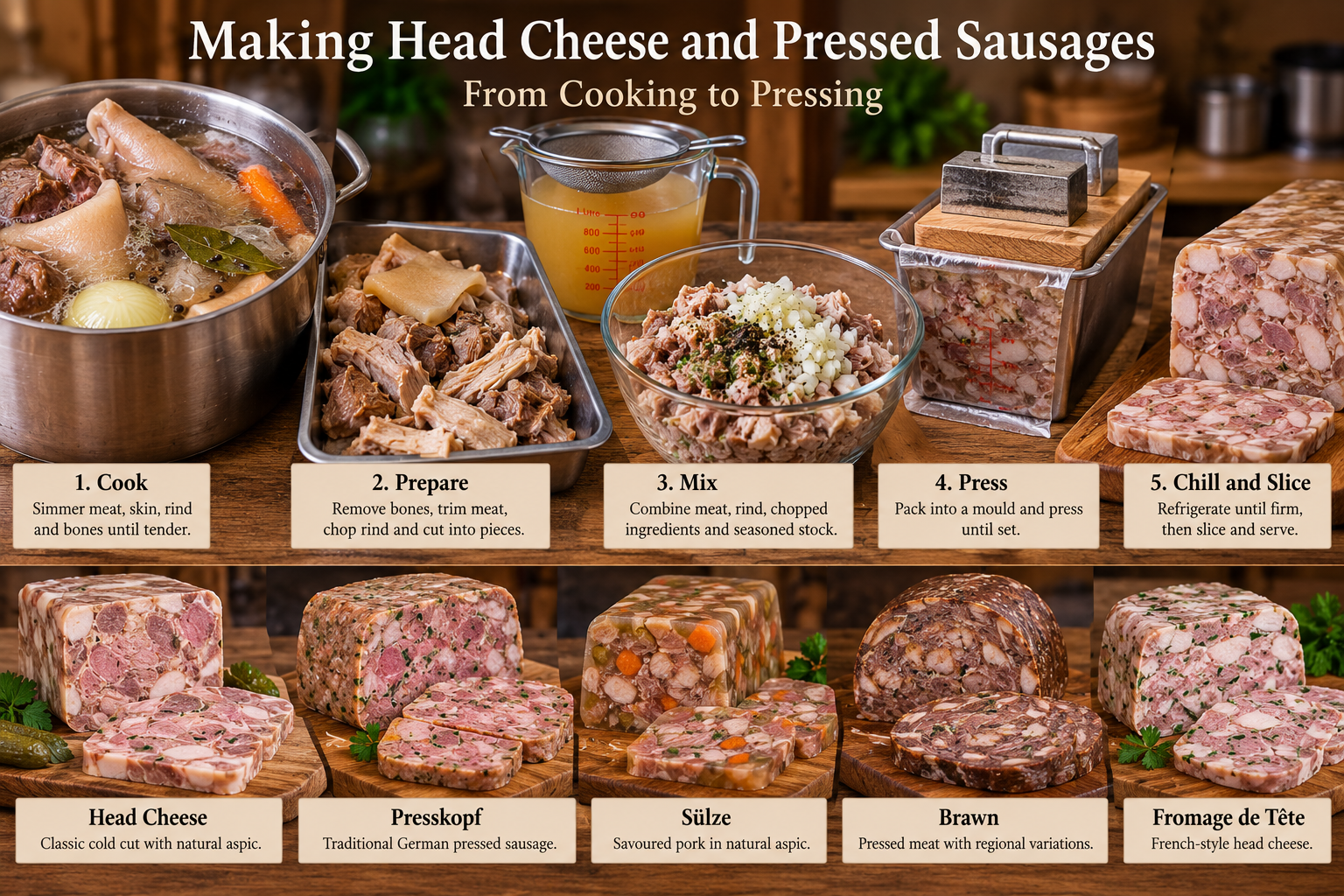
Head cheese is one of those traditional charcuterie products that sounds much more complicated than it really needs to be.
The name alone can be confusing. There is no cheese involved, and although many traditional versions were made from a pig’s head, that doesn't mean we have to start with one in our home kitchen.
What makes these products interesting is the way cooked meat, collagen-rich stock, cooling and sometimes gentle pressing work together to create something that can be sliced and served cold.
Once we understand those principles, products such as German Presskopf, Presssack and Sülze, British brawn and French fromage de tête become much easier to understand.
And, as usual, we don't need a professional butcher's shop to explore these techniques.
What Is Head Cheese?
Head cheese is a cooked meat preparation traditionally made from parts of the pig that contain plenty of skin, connective tissue and collagen.
Historically, the head was an obvious choice because it provided meat, skin and connective tissue in one economical cut.
After cooking, the edible meat and other selected parts were removed from the bones, chopped or cut into pieces, seasoned and packed into a casing or mould.
As the preparation cooled, gelatin from the cooking stock helped hold everything together.
The result was a firm, sliceable cold meat product.
Today, similar results can often be achieved with more convenient cuts such as pork knuckle, pork hock, cheek, shoulder and additional pork rind, provided the chosen recipe supplies the necessary meat and collagen.
Head Cheese, Sülze and Pressed Sausages: What Is the Difference?
These names describe overlapping families of traditional products rather than completely separate techniques.
Head cheese is a broad English name for cooked meat preparations traditionally associated with the pig’s head.
Brawn is a British term commonly used for similar preparations.
Fromage de tête is the French name for traditional head cheese.
Presskopf and Presssack are German regional names associated with cooked, often pressed or tightly packed meat preparations. Their ingredients and appearance vary considerably.
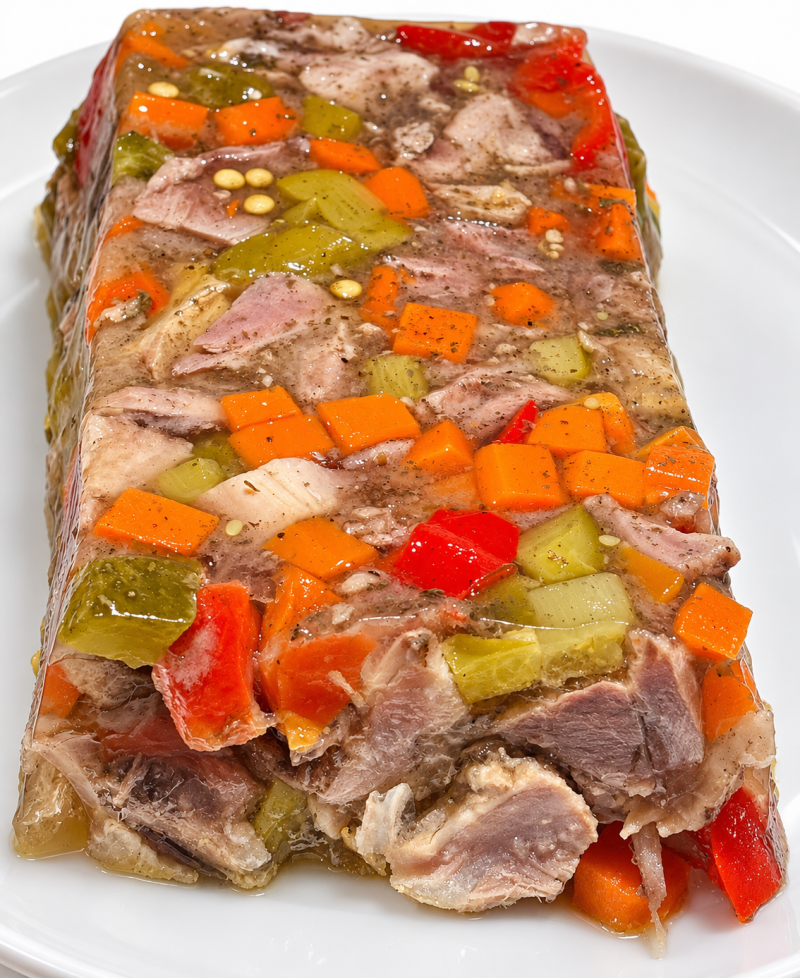
Sülze commonly describes cooked meat set in a savoury gelatin-rich jelly, frequently with a pleasantly acidic flavour.
Some versions contain clearly visible aspic around the meat. Others are tightly packed, with very little visible jelly.
And despite the names, not every Presssack is mechanically pressed, and not every Sülze requires a traditional sausage casing.
The exact preparation depends on the regional style.
The Most Important Ingredient Is Often Collagen
One of the most useful things to understand about head cheese is that its structure frequently comes from collagen-rich ingredients rather than from finely mixed sausage proteins.
Collagen is found in connective tissue, skin and other parts of the animal.
During prolonged moist cooking, some of this collagen is converted into gelatin.
When the gelatin-rich cooking liquid cools, it can form a gel that holds pieces of meat together.
This is the same principle we explored in our Schweinesülze recipe made from pork knuckle.
We aren't creating an ordinary sausage emulsion. We are using the natural gelatin in the cooking stock to bind pieces of cooked meat.
Choosing Suitable Meat and Collagen-Rich Ingredients
Different cuts contribute different things to the finished product.
- Pork knuckle or hock: provides meat, skin and connective tissue, making it particularly useful for home production.
- Pork cheek: contributes rich, flavourful meat and some connective tissue.
- Pork shoulder: provides substantial lean meat but may require an additional source of gelatin.
- Pork rind: contributes collagen and can also become part of the finished texture.
- Traditional head cuts: provide a mixture of meat, skin and connective tissue but require careful preparation and deboning.
We don't need to use every possible ingredient. What matters is understanding which ingredients provide meat and which provide the gelatin needed to hold the product together.
Why Gentle Cooking Matters
Most traditional head-cheese preparations begin by cooking the meat and collagen-rich ingredients in water or stock.
The aim is to make the meat tender, soften the skin and connective tissue, and extract gelatin into the cooking liquid.
A gentle simmer is generally preferable to an aggressive rolling boil.
Excessively vigorous boiling can break the meat apart, emulsify fat into the stock and make it harder to obtain a relatively clear jelly.
The exact cooking time depends on the cuts, their size and the recipe. A large pork knuckle will not behave like small pieces of boneless shoulder.
Use a suitable food thermometer and make sure the meat is thoroughly cooked before proceeding.
Don't Throw Away the Cooking Stock
In many head-cheese preparations, the cooking liquid is just as valuable as the meat.
After cooking, the stock contains dissolved gelatin, flavour and sometimes a considerable amount of fat.
It is usually strained to remove bones, small particles and other unwanted material.
Depending on the desired result, some fat may also be skimmed away.
The stock may then be reduced to concentrate its gelatin and flavour.
But there is an important distinction: reducing stock concentrates what is already there. It does not guarantee that the stock contains enough gelatin to set.
How to Test the Natural Gelatin
One of the simplest and most useful home techniques is the cold-plate test.
Take a small sample of strained stock, place it on a cold plate or in a small dish and refrigerate it until it has cooled sufficiently to show whether a gel forms.
If the stock sets into a reasonably firm but tender jelly, it may already contain enough natural gelatin for the intended preparation.
If it remains almost liquid, the stock may need further reduction or the recipe may require an additional gelatin source.
Remember that the desired firmness varies. A lightly set Sülze with visible jelly does not need exactly the same texture as a densely packed Presskopf.
The cold-plate test is a useful kitchen check, not a precise measurement of gelatin concentration.
Do We Need Commercial Gelatin?
Not necessarily.
Traditional head cheese frequently relies on gelatin extracted from the animal itself.
However, the amount extracted varies with the cuts used, the proportion of skin and connective tissue, the cooking method and the amount of liquid.
If a reliable recipe calls for additional gelatin, there is nothing wrong with using it.
What we want to avoid is adding large amounts automatically and ending up with meat suspended in an unpleasantly rubbery block.
The aim is a product that holds together when sliced but remains pleasant and tender to eat.
Preparing the Cooked Meat
After cooking, the meat is removed from the stock and allowed to cool enough for safe handling.
Bones, cartilage and other unwanted parts must be removed carefully.
This is particularly important when using head cuts or bone-in knuckles, where small bones and hard fragments can be easy to overlook.
The edible meat can then be cut into pieces appropriate for the intended product.
Large, attractive pieces give a rustic appearance. Smaller pieces produce a more uniform slice.
Some recipes also include finely chopped cooked rind to improve binding and contribute texture.
There is no universal cutting size. The finished style determines how the meat should be prepared.
Seasoning the Mixture
Head cheese and pressed sausages are often seasoned with familiar European charcuterie spices.
Depending on the regional style, these may include black or white pepper, allspice, marjoram, nutmeg, bay leaf, mustard seed, garlic or onion.
Some Sülze preparations also contain vinegar, pickled vegetables or other acidic ingredients that give the finished product a refreshing character.
One practical point is that seasoning tastes different when cold.
A warm cooking stock may taste well seasoned, yet the finished refrigerated product can seem noticeably milder.
This is why traditional recipes often pay particular attention to seasoning the stock before filling the mould.
However, extra vinegar or salt should be used for flavour, not as an improvised preservation method.
Filling a Mould or a Casing
One of the great advantages of making head cheese at home is that we don't necessarily need sausage casings.
A simple loaf tin can produce an attractive, sliceable product.
Other suitable food-safe moulds may also be used.
Traditional pressed sausages may instead be filled into large natural or suitable manufactured casings.
Whichever method is used, the mixture needs to be distributed evenly.
Large air pockets should be avoided, and the meat should be arranged so that the finished product holds together and slices attractively.
When using a mould, a small amount of stock can help fill spaces between the meat pieces.
When using a casing, avoid overfilling and follow the particular recipe's instructions for closing, cooking and cooling.
What Does Pressing Actually Do?
Pressing is another important technique, but it is often misunderstood.
The main purpose is to compact the cooked meat, reduce empty spaces and help create a firm, uniform shape.
Depending on the preparation, pressing may also remove some excess liquid.
However, pressing does not create gelatin and cannot replace a properly balanced formulation.
A product with insufficient natural binding may still fall apart when sliced, even after being pressed firmly.
Likewise, excessive pressure may squeeze out too much liquid or produce an unnecessarily dense texture.
Pressing improves the structure of a suitable mixture. It does not repair an unsuitable mixture.
Do All Head Cheeses Need Pressing?
No.
Some traditional products are pressed to produce a dense, compact slice.
Others are packed into a mould and simply allowed to set as the gelatin-rich stock cools.
This distinction is particularly important when comparing Presskopf with a more jelly-rich Schweinesülze.
In a Sülze, we may actually want the clear aspic to remain visible around the meat.
Pressing that product too firmly would change its appearance and character.
The desired result should determine whether pressing is necessary.
Cooling and Setting
Gelatin-rich products become firmer as they cool, but cooling is also an important food-safety step.
Cooked meat should not be left for hours at room temperature while waiting for the jelly to set.
Use suitably sized containers, avoid unnecessarily deep or oversized portions, and refrigerate promptly.
Large, densely packed moulds cool more slowly than shallow containers, so cooling needs particular attention.
For home production, it is often more practical to divide a large batch into smaller moulds rather than making one enormous loaf.
Allow enough refrigerated time for the product to set completely before slicing.
A firm exterior does not necessarily mean that the centre has cooled adequately.
Removing the Product from the Mould
Once thoroughly chilled and set, a moulded head cheese can usually be removed without special equipment.
Depending on the mould, carefully loosening the edges or briefly warming the outside may help release the product.
Take care not to warm the finished meat unnecessarily.
A sharp knife will produce cleaner slices than a blunt one, especially when the product contains large pieces of meat surrounded by tender aspic.
Common Problems and What They Tell Us
The Head Cheese Does Not Set
The stock may not contain enough gelatin, may have been diluted too much, or may not have been reduced sufficiently.
Check the recipe, the cuts used and the stock preparation. For future batches, a cold-plate test can help identify the problem before filling the mould.
The Jelly Is Too Firm or Rubbery
The gelatin concentration may be excessive, particularly if commercial gelatin was added unnecessarily.
The goal is a pleasant, tender gel rather than maximum firmness.
The Product Falls Apart When Sliced
Possible causes include insufficient binding, large spaces between meat pieces, unsuitable proportions or cutting before the product has set fully.
Pressing alone is not always the answer.
The Jelly Is Cloudy
Cloudiness can result from vigorous boiling, suspended particles or fat dispersed into the stock.
Gentle cooking, careful straining and appropriate fat removal can improve clarity.
Cloudiness by itself is not a reliable indicator of food safety.
The Finished Product Is Too Fatty
Excess fat may have remained in the cooking stock or the formulation may contain more fatty tissue than intended.
Removing excess surface fat from the stock can help, although some fat may be an intentional part of the finished product.
The Meat Is Too Soft or Shredded
Overcooking or rough handling can cause the meat to break apart.
If a rustic appearance with distinct meat pieces is desired, the meat should remain sufficiently intact to be cut and arranged.
Food Safety for Head Cheese and Pressed Sausages
Head cheese is a cooked, highly perishable meat product.
Although traditional recipes may contain salt, vinegar, spices or curing salt, these ingredients do not automatically make the finished product safe for room-temperature storage.
Good hygiene is especially important when handling cooked meat after cooking, because the meat is often deboned, cut, seasoned and packed by hand.
- Start with fresh meat from a reliable source.
- Cook the meat thoroughly using a suitable, reliable process.
- Use clean equipment and work surfaces.
- Prevent raw ingredients from contaminating cooked meat.
- Remove bones and hard fragments carefully.
- Avoid unnecessary delays between cooking, filling and cooling.
- Refrigerate promptly and keep the finished product at 4°C (40°F) or below.
- Do not assume that a sealed mould, casing or jar makes the product shelf-stable.
For ordinary homemade head cheese, a conservative storage guideline is to consume it within 3–4 days under proper refrigeration.
Can Head Cheese Be Frozen?
Technically, many cooked meat preparations can be frozen.
However, head cheese containing substantial amounts of natural aspic is not always a good candidate for freezing.
After thawing, the jelly may lose some of its structure, become watery or release liquid.
The meat may remain usable from a quality perspective, but the attractive, cleanly sliced appearance can suffer.
For a traditional Sülze with visible natural aspic, refrigeration and relatively quick consumption are usually preferable.
What About Preserving Head Cheese in Jars?
This is where we need to distinguish between a refrigerated product and a genuinely shelf-stable canned product.
Placing cooked head cheese into a jar and closing the lid does not make it safe for storage at room temperature.
Meat is a low-acid food, and shelf-stable preservation requires an appropriate scientifically tested pressure-canning process for the exact product.
Dense meat mixtures, gelatin-rich preparations and variations in formulation can affect heat penetration.
We should therefore not assume that a standard pressure-canning process for plain meat automatically applies to head cheese or Presssack.
For ordinary home production, the simplest and most dependable approach is to prepare the product for refrigerated storage.
Do We Need Special Equipment?
Not necessarily.
Many home versions can be prepared with ordinary kitchen equipment:
- A sufficiently large cooking pot
- An accurate food thermometer
- A fine sieve
- A sharp knife and cutting board
- A suitable food-safe mould or loaf tin
- A refrigerator with enough space for prompt cooling
A dedicated press or large sausage casing may be useful for certain traditional preparations, but neither is essential for learning the basic principles.
Where Should a Beginner Start?
For someone making head cheese for the first time, a pork-knuckle preparation in a loaf tin is an excellent introduction.
It demonstrates the important techniques without requiring a pig’s head, a large casing or a special sausage press.
You learn how to extract natural gelatin, prepare cooked meat, test the stock, fill a mould and produce a firm, sliceable finished product.
Once those principles are familiar, it becomes much easier to explore more traditional Presskopf, Presssack and other regional varieties.
Final Thoughts
Head cheese and pressed sausages are wonderful examples of how traditional sausage making uses techniques that are both economical and surprisingly practical.
The process isn't about forcing meat into a particular shape.
It is about understanding how cooked meat, collagen, gelatin-rich stock, careful packing, optional pressing and controlled cooling work together.
Once we understand that relationship, the names and regional variations become much less intimidating.
Good head cheese begins with properly prepared meat and suitable natural binding. The mould or press simply helps give the finished product its shape.
Dieter’s Tip: Before buying a special head-cheese press or large casings, try working with a simple loaf tin. Learn how the cooking stock sets, how the meat behaves when packed and how much gelatin is actually needed. Once you understand those basics, moving on to traditional pressed sausages becomes much easier.