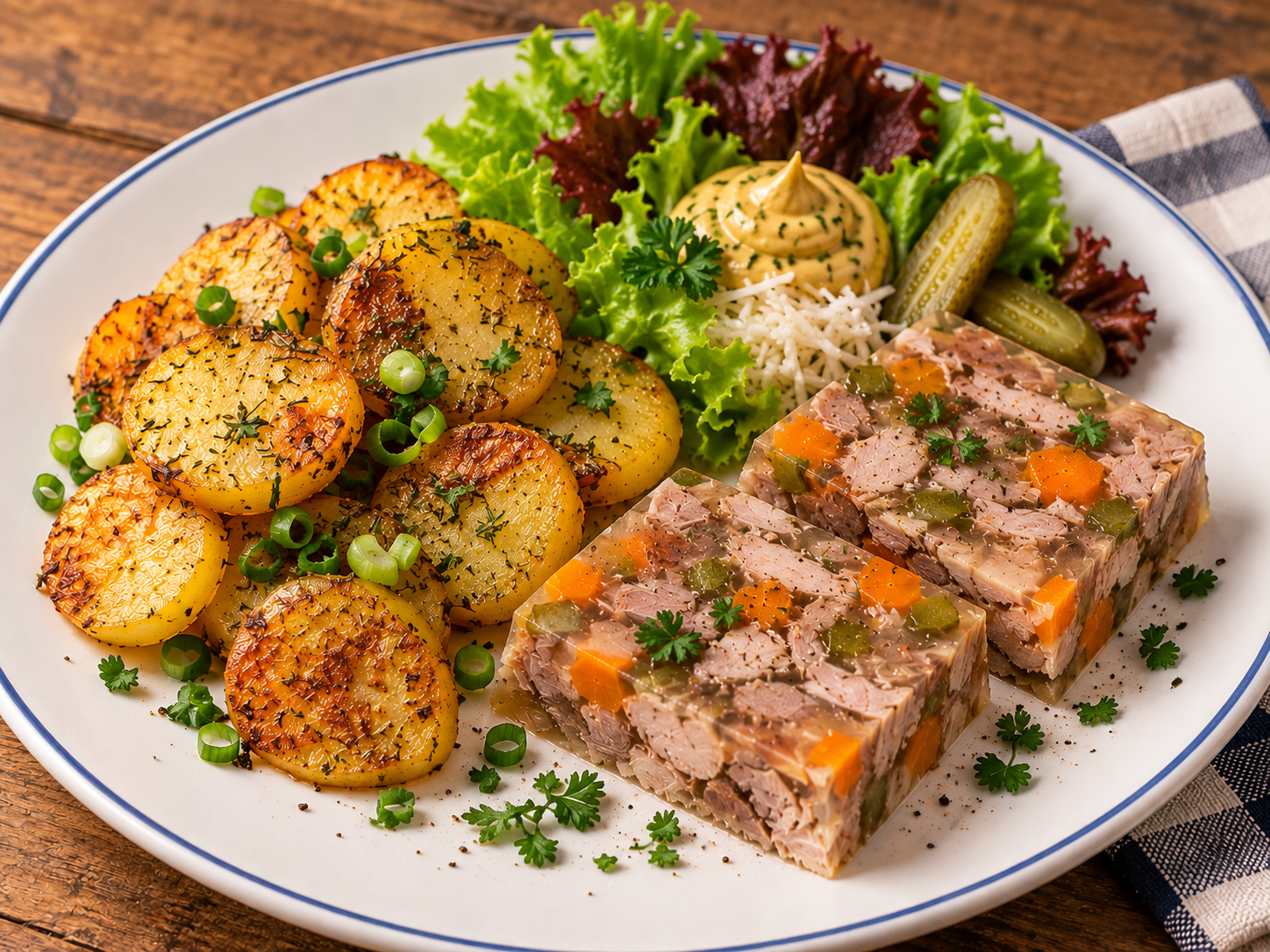
Schweinesülze – German Pork Knuckle in Natural Aspic

2026-10-02 19:25

A classic German-style Schweinesülze made from slowly cooked pork knuckle set in its own naturally collagen-rich stock. Prepared in a simple loaf tin, this recipe shows how pork knuckle can produce a beautifully firm aspic without automatically reaching for commercial gelatin.

German Pork in Natural Aspic

Schweinesülze is one of those traditional preparations that demonstrates just how much can be achieved with a relatively inexpensive cut of pork and very little specialised equipment.

At its heart, Sülze is cooked meat suspended in a savoury, lightly acidic jelly. Similar preparations can be found throughout Germany and neighbouring countries under names such as Sülze, Presssack, Presskopf, brawn and head cheese, although the ingredients and preparation vary considerably from region to region.

For this version, we are keeping things particularly practical for the home kitchen.

Instead of using a pig's head or filling the finished mixture into a large casing, we are using a skin-on pork knuckle and an ordinary loaf tin.

The pork knuckle is ideal because the skin, connective tissue and bones release a considerable amount of collagen during the long, gentle cooking process. Once the cooking liquid is strained and reduced, that collagen can often provide everything we need to produce a firm natural aspic.

That gives us an important lesson before we even begin:

Don't automatically add gelatin to Sülze. First find out whether the pork has already provided enough natural gelatin of its own.

Dieter's Tip: Don't throw away that pork-knuckle cooking liquid and immediately reach for commercial gelatin. Strain the stock, reduce it and chill a spoonful first. Pork knuckle is naturally rich in collagen, and you may already have all the gelatin you need. The goal is a Sülze that slices cleanly but still feels tender on the plate — not pork trapped inside a block of rubbery jelly.
Recipe

A classic German-style Schweinesülze made with tender pieces of slowly cooked pork knuckle suspended in a savoury, lightly tangy natural aspic. The collagen-rich pork stock gives the Sülze its characteristic firm yet tender texture, while gherkins, vinegar, marjoram and warm spices balance the richness of the pork. Chilled and sliced from a simple loaf tin, it makes a rustic cold dish that is particularly good with potatoes, bread, mustard and pickles.

Recipe Overview

Difficulty
Intermediate
Yield
1000 g
Category
Charcuterie
Region
German

Equipment Needed

Large cooking pot Fine sieve Knife and chopping board Small saucepan Loaf tin Small plate or ramekin for testing the stock

Ingredients

Meat and Fat

  • 1400 g Pork Knuckle
  • 700 g Cooked Lean Pork — For the Sülze

Seasoning

  • 10 g Salt — For Cooking Stock
  • 1 tsp Mustard Seeds — For Cooking Stock
  • 0.5 tsp Allspice — For Cooking Stock
  • 8 pcs Black Pepper Corns — For Cooking Stock
  • 4 pcs Bayleaf — For Cooking Stock
  • 2 g White Pepper — For the Sülze
  • 0.5 g Dried Marjoram — For the Sülze
  • 1 g Sugar — For the Sülze

Fresh Additions

  • 1 stalks Celery — For Cooking Stock
  • 1 pcs Carrot — For Cooking Stock
  • 1 pcs Onion — For Cooking Stock
  • 60 g Pickled Gherkins — For the Sülze
  • 40 g Cooked Carrot — For the Sülze

Liquids

  • 1000 ml Water — For Cooking Stock
  • 30 ml White Wine Vinegar — For the Sülze
  • 300 ml Reduced Pork Stock — For the Sülze

Additional Ingredients

  • 8 g Gelatine Powder — Optional if your stock does not have enough natural gelatine to set on its own.

Method

Preparation

  1. Roughly chop celery and the carrot.

Cooking

  1. Put the pork knuckle in a large cooking pot and add enough water to cover the meat.
  2. Bring the liquid gradually up to temperature and then cook the pork knuckle gently at approximately 85–90°C (185–194°F).
  3. While the water is heating up skim of any foam from the top.
  4. I no more foam appears add all ingredients market with "For Cooking Stock".
  5. Cook gently at 85–90°C (185–194°F) for 3 to 3.5 hours.
  6. While your knuckle is cooking peel and cook 1 large carrot.
  7. While your knuckle is cooking dice the cooked carrot and the pickled gherkins.
  8. While your knuckle is cooking prepare the other ingredients marked "For the Sülze".

Processing

  1. Remove the pork knuckle from the liquid and let it cool just enough to handle.
  2. Strain the cooking liquid through a fine sieve and start gently reducing it. For the final product you will need about 300 ml.
  3. Meanwhile remove the bones, connecting tissue and remaining fat from the knuckles. Keep some of the skin.
  4. Cut the lean meat in to 1.5 to 2 cm cubes.
  5. While your stock is reducing, take a table spoon out on a plate and put into the fridge for at least 10 to 15 minutes. If it sets and doesn't drip of the plate the stock is reduced enough and contains sufficient gelatin to finish the sülze.
  6. If the previous step is not satisfactory, continue reducing the stock and repeat the test until you are satisfied with the result or your stock is reduced to just over 300 ml. If your test at this point does not form a sufficient gelatin you need to add some gelatin powder.
  7. Finely chop about 50 to 80 g of the saved skin and gently mix it with the diced gherkins and carrots under the cut meat cubes.
  8. Just before removing from the heat add the dry spices marked with "For the Sülze" to the reduced stock. Taste the stock and add salt to taste and if needed a bit more vinegar. It should taste slightly over-spiced. It will loose as it cools down in the finished product.

Finishing

  1. Slightly wet the loaf tin and add a small amount of reduced stock just to cover the bottom of the tin. Refrigerate until the stock starts to set.
  2. Add some of the most attractive pieces of meat on the bottom of the tin. This is forms the visible top when unmould.
  3. Add the rest of the meat on top.
  4. Fill in the still warm (NOT hot), seasoned, reduced stock until all the meat is covered. Slightly tap the loaf tin to let possible trapped air escape.

Resting

  1. Refrigerate until the gelatin is firmly set. Best over night.
  2. To unmould run a thin knife carefully around the edge. Dip the outside of the loaf tin briefly in warm water, just a few seconds, and invert it onto a board or serving plate.

Additional Guidance

Cooking Notes

To release the natural gelatin slow cooking at 85–90°C (185–194°F) and time is the important part of it. Rather keep it at 85° and 3.5 hours than substitute time with a higher temperature.

Resting and Cooling

Best keep in the fridge over night so everything sets properly.

Storage

Refrigerated at 4° or below 4 to 5 days. You can store it longer frozen but it is not recommended. It will loose on quality after defrosting.

Serving Suggestions

Schweinesülze is traditionally served cold. It is excellent with fried or boiled potatoes, rustic bread, pickles and mustard. A little additional vinegar or a simple vinaigrette also works particularly well with the rich pork and cool aspic. For a German-style meal, serve generous slices of Sülze alongside potatoes and a crisp salad.

Additional Notes

Before adding commercial gelatin, test the stock. Place approximately one tablespoon of the reduced stock on a cold plate or in a small ramekin and refrigerate it for around 10–15 minutes. If it becomes a firm jelly when cold, the stock already contains enough natural gelatin and there is no reason to add commercial gelatin. If it remains very soft or almost liquid, return the stock to the saucepan, reduce it a little further and test it again.

Sausage Specifications

Freezer Friendly Yes

You May Also Like


Back to Blog

Stay Updated

Receive new sausage recipes, practical sausage-making tips and occasional updates.

You will receive an email asking you to confirm your subscription. You can unsubscribe at any time.