Blood sausage can seem like one of the more intimidating areas of traditional sausage making.
For generations, however, blood sausages were simply a practical part of using as much of an animal as possible. Instead of wasting a nutritious ingredient, blood was combined with meat, fat and other ingredients to produce sausages that could be rich, savoury and remarkably varied.
Today we find blood sausages throughout Europe and far beyond. German Blutwurst, British black pudding, French boudin noir, Spanish morcilla and many Nordic and Eastern European sausages all belong to the same broad family, yet their textures and flavours can be completely different.
Some are smooth and soft. Others are coarse and packed with visible pieces of meat and fat. Some contain barley, oats or rice, while others contain little or no cereal at all.
The important point is that blood sausage is not simply blood stuffed into a casing.
Blood provides the sausage with much of its identity, colour and characteristic flavour, but the balance of blood, meat, fat and the other ingredients determines whether the finished sausage is succulent and tender or dry, crumbly and excessively firm.
What Is Blood Sausage?
Blood sausage is a broad term for sausages in which edible animal blood forms an important part of the mixture.
Pork blood is particularly common in European blood sausages, although different traditions may use blood from other food animals.
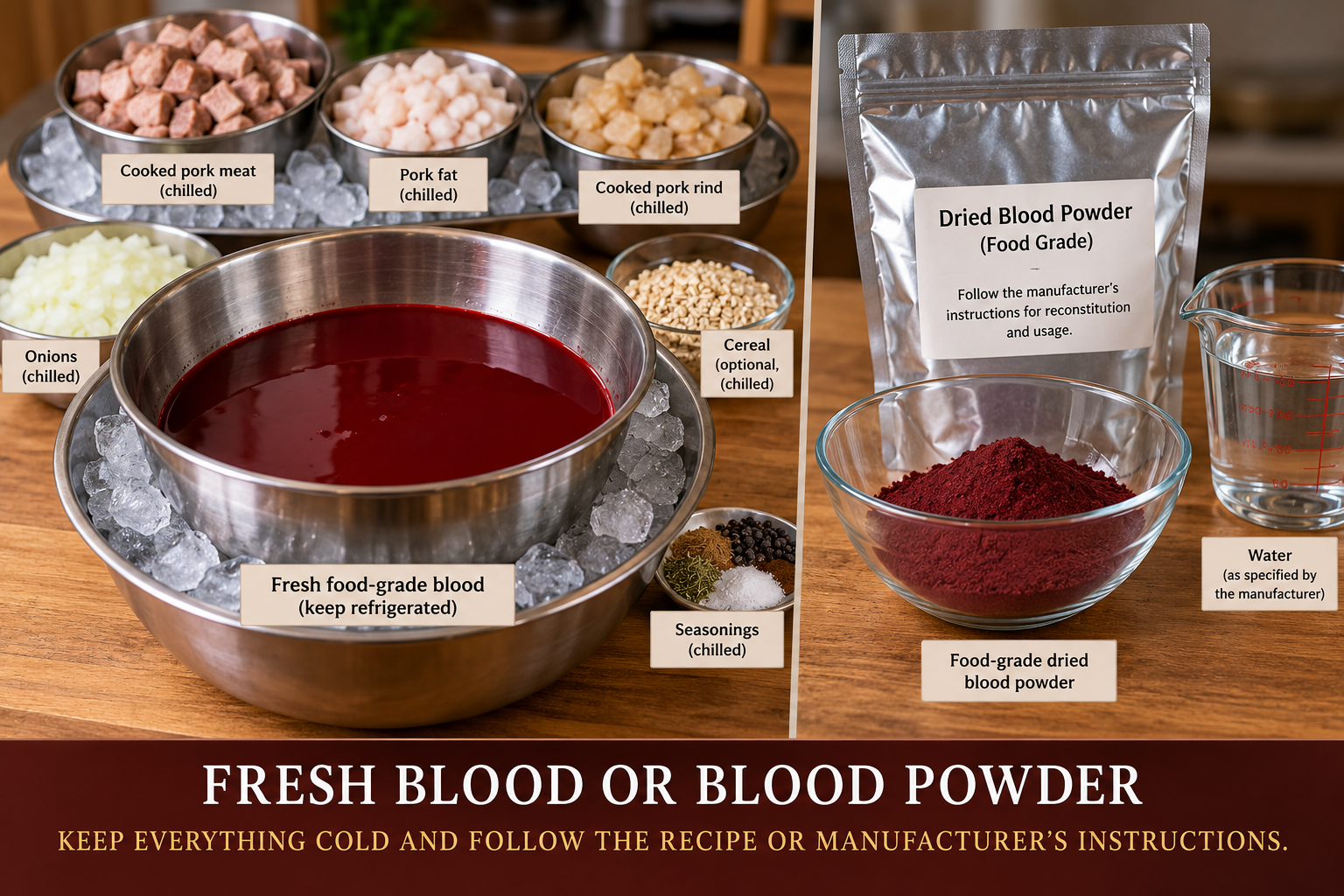
Depending on the regional style, the blood may be combined with ingredients such as:
- Cooked pork meat
- Pork fat or back fat
- Pork belly
- Cooked pork rind
- Onions
- Stock
- Barley
- Oats
- Rice
- Bread or breadcrumbs
- Herbs and spices
This is why two sausages that both contain blood can have completely different textures.
What Does Blood Do in a Sausage?
Blood isn't there simply to provide colour.
It contains proteins that coagulate when heated. As the sausage cooks, these proteins help bind the mixture together and contribute to the characteristic texture of the finished sausage.
This means that the amount of blood in the formulation affects much more than flavour.
Too little may produce a sausage that lacks the expected character and binding. Too much, or an unsuitable balance with the other ingredients, can produce an excessively dense or firm result.
Think of blood as both a characteristic ingredient and a structural ingredient.
Blood Sausage Is More Than Blood
Just as liver doesn't create a good liver sausage by itself, blood alone doesn't create a good blood sausage.
The supporting ingredients are equally important.
Cooked meat provides body and texture. Fat provides richness and succulence. Cooked rind can contribute additional binding and gelatin. Onions contribute sweetness and aroma, while cereal ingredients can absorb moisture and completely change the character of the sausage.
A coarse German Blutwurst containing visible cubes of pork and fat therefore behaves very differently from a softer boudin noir or a cereal-rich black pudding.
Rather than thinking of one universal blood-sausage formula, it is better to understand blood sausage as a family of products.
Fresh Blood
If fresh blood is used, it must be food-grade blood obtained from a suitable and trustworthy source.
Blood collected without appropriate hygienic controls should not be treated as a suitable food ingredient simply because it came from an animal intended for food.
Fresh blood is highly perishable. It should therefore be kept properly refrigerated and handled with the same attention to hygiene and cross-contamination that we would give other raw animal ingredients.
Don't leave fresh blood sitting in a warm kitchen while the other sausage ingredients are being prepared.
Keep it refrigerated until it is required.
Preventing Fresh Blood from Coagulating Too Early
One of the practical difficulties with fresh blood is that it naturally wants to clot.
Commercial food-grade blood may already have been treated or stabilised appropriately for its intended use. When purchasing blood, find out exactly what product you have and follow the supplier's handling instructions.
Don't casually add an anticoagulant or other substance to fresh blood based on an improvised formula.
If a traditional recipe requires a particular treatment for fresh blood, follow a reliable recipe designed for that blood product and process.
Dried Blood Powder
For many home sausage makers, obtaining fresh food-grade blood is difficult.
Food-grade dried blood powder can provide a practical alternative where an appropriate product is available.
The powder is generally reconstituted with water before being incorporated into the sausage mixture, but there is an important point:
Don't assume that every blood powder is reconstituted at the same ratio.
Products differ in composition and concentration. Follow the reconstitution and usage instructions supplied by the manufacturer of the exact product you are using.
A universal statement such as “one part powder to a certain number of parts water” may work for one product and be completely inappropriate for another.
Fresh Blood or Blood Powder?
Both can have a place in home sausage making.
Fresh food-grade blood can provide a very traditional approach and may be specified by a particular recipe.
Dried blood powder is easier to transport and store before reconstitution and may be considerably easier for the home sausage maker to obtain.
Neither should automatically be substituted for the other without adjusting the recipe appropriately.
If a recipe was developed using fresh blood and you want to use blood powder instead, use a conversion appropriate to the exact powder and make sure the final quantity of reconstituted blood corresponds with the formulation.
The Role of Pork Rind
Cooked pork rind appears in many traditional blood-sausage formulations for good reason.
When cooked until tender, rind contains collagen that becomes gelatin and can contribute body and binding to the finished sausage.
Depending on the recipe, the rind may be finely ground or processed while warm before being incorporated into the mixture.
This is another example of why the usual rules for a fresh sausage cannot simply be copied over to every cooked sausage.
Some traditional blood sausages intentionally combine warm pre-cooked ingredients with blood shortly before stuffing and cooking.
That does not mean raw animal ingredients should simply be left warm on the worktop. Follow the temperature sequence specified by the particular recipe.
Meat and Fat
Blood sausage doesn't necessarily need large quantities of lean meat, but meat and fat can have an enormous influence on its character.
Coarse Blutwurst may contain clearly visible pieces of cooked pork and fat. Other sausages use more finely processed ingredients.
Fat is especially important because blood itself doesn't provide the succulent mouthfeel we associate with fat.
A poorly balanced blood sausage can therefore taste surprisingly dry even though the mixture appeared quite wet before cooking.
Cereals, Rice and Bread
Not every blood sausage contains cereal.
However, cereals and other starch-rich ingredients are characteristic of many regional styles.
British black pudding commonly uses cereal ingredients, while different forms of morcilla may contain rice or other additions. Other traditional blood sausages rely more heavily on meat, fat and rind.
These ingredients don't merely make the sausage cheaper or increase its volume.
They absorb liquid, influence binding and have a major effect on the final texture.
For that reason, don't add oats, barley, rice or breadcrumbs to a blood-sausage recipe simply because the mixture appears too wet. Changing the amount of an absorbent ingredient changes the formulation of the sausage.
Onions
Onions are particularly common in blood sausages and can provide sweetness that balances the mineral character of blood.
Depending on the recipe, they may be gently cooked before being added to the mixture.
Raw and cooked onions behave differently, so follow the method specified by the recipe rather than treating them as interchangeable.
Seasoning Blood Sausage
Blood sausages often tolerate assertive seasoning particularly well.
Common seasonings in different European traditions include:
- Black pepper
- White pepper
- Marjoram
- Allspice
- Nutmeg
- Mace
- Clove
- Ginger
- Caraway
- Thyme
Which combination is appropriate depends on the style of sausage being made.
A German Blutwurst shouldn't automatically receive the same spice profile as a British black pudding or Spanish morcilla.
Salt and Curing Salt
Some blood-sausage recipes use ordinary salt, while others use an appropriate curing salt as part of the formulation.
Follow the recipe rather than assuming that curing salt is always required or that ordinary salt can always replace it.
Remember that European nitrite curing salt and concentrated products such as American Cure #1 are not interchangeable gram for gram.
The correct amount depends on the concentration of the curing product and the formulation being followed.
Coarse and Fine Blood Sausages
Texture is one of the major differences between blood-sausage styles.
A coarse sausage may contain visible pieces of cooked meat, fat and rind suspended in the dark blood mixture.
A finer sausage may use more finely processed ingredients to produce a softer and more uniform texture.
Neither is inherently better.
The important thing is to process the ingredients according to the style of sausage you are trying to make.
Mixing
Once blood is incorporated, the mixture may be considerably more fluid than the filling for an ordinary fresh sausage.
Don't immediately assume something has gone wrong.
Remember that the proteins in the blood will coagulate during cooking and that ingredients such as rind or cereal may also contribute to the final structure.
At the same time, a mixture that is much thinner or thicker than the recipe describes should not simply be corrected by randomly adding flour, breadcrumbs or liquid.
Check the formulation first.
Stuffing Blood Sausages
Blood-sausage mixtures can be soft and sometimes quite fluid, so stuffing requires a little patience.
Natural pork casings and larger casings are commonly used depending on the style.
Don't stuff the casings excessively tightly.
The filling changes as it cooks, and an overfilled casing is more likely to split.
Work cleanly, wipe away spilled filling promptly and keep raw mixture away from ready-to-eat foods and clean equipment.
Cooking Blood Sausages
Many traditional blood sausages are gently cooked in hot water after stuffing.
A violent boil is unnecessary and can increase the chance of casings splitting and fat separating from the mixture.
The temperature of the cooking water and the internal temperature of the sausage are two different measurements.
For a home recipe based on raw or ground pork ingredients, the finished sausage should reach at least 71°C (160°F) internally, measured with a food thermometer, unless you are following a properly validated process specifying another safe time-and-temperature combination.
If poultry forms part of the formulation, the applicable safe cooking requirement may be higher, so follow the requirements for the ingredients and the specific recipe.
Don't judge doneness from colour. Blood sausage is naturally dark, making visual assessment particularly unreliable.
Cooling After Cooking
Once the sausages have finished cooking, they need to be cooled promptly.
Depending on the recipe, this may involve initial cooling in cold water followed by refrigeration.
Don't leave a large batch of warm cooked blood sausages sitting at room temperature for hours.
The aim is to move the finished product through the cooling stage efficiently and into refrigeration.
Common Problems
The Sausage Is Dry and Crumbly
This can result from an unsuitable balance between blood, meat, fat and absorbent ingredients, or from excessive cooking.
Adding more liquid without understanding the formulation is not necessarily the solution.
The Sausage Is Too Firm or Rubbery
Too much binding, an unsuitable blood proportion or excessive cooking can contribute to an overly firm texture.
The Filling Falls Apart
The formulation may not contain sufficient binding, the ingredients may not have been processed correctly, or the sausage may not have been cooked according to the intended method.
Fat Separates
Excessive heat can encourage fat to separate from the sausage mixture.
Gentle, controlled cooking is preferable to aggressive boiling.
The Casings Split
Common causes include overfilling, excessive cooking temperature, trapped air and rapid expansion of the filling.
Food Safety
Blood sausage deserves particularly careful hygiene because blood is a raw animal ingredient and the mixture may also contain raw or cooked meat, fat and other highly perishable ingredients.
- Use only blood intended for human consumption.
- Keep fresh blood properly refrigerated.
- Keep raw ingredients separated from ready-to-eat foods.
- Wash hands, utensils and work surfaces thoroughly.
- Follow the recipe's cooking process completely.
- Use a food thermometer rather than relying on colour.
- Cool cooked sausages promptly.
- Keep the finished sausage refrigerated.
Unless the product has been made using a specifically validated shelf-stable process, homemade blood sausage should be considered a perishable refrigerated product.
Storage and Freezing
Cooked homemade blood sausage should be refrigerated promptly and kept at 4°C (40°F) or below.
As a conservative home-storage guideline, consume cooked blood sausage within 3–4 days.
Blood sausage can generally be frozen, although the quality after thawing depends on the formulation. Sausages containing cereal, rice or substantial amounts of gelatin-rich rind may show some change in texture after freezing and thawing.
For best results, freeze in practical portions, wrap well or vacuum seal, and thaw in the refrigerator.
Different Traditions, Different Sausages
| Style | General Character |
|---|---|
| German Blutwurst | Ranges from fine and spreadable to coarse sausages with visible pork and fat |
| British Black Pudding | Usually firm and sliceable, commonly containing cereal |
| French Boudin Noir | Often softer and finely textured, frequently with onion |
| Spanish Morcilla | Highly regional; may contain rice, onion or other characteristic additions |
| Nordic Blood Sausages | Numerous regional styles using blood with cereals, meat, fat or other local ingredients |
The differences are exactly what make blood sausage such an interesting subject.
Once we understand what the blood contributes, we can begin to understand why these sausages can share one defining ingredient yet produce completely different results.
Can Blood Sausage Really Be Made in a Home Kitchen?
Absolutely — provided suitable food-grade ingredients are available and the recipe is designed for safe home production.
You don't need a professional butcher's shop.
Depending on the recipe, ordinary equipment such as a pot, grinder, food processor, sausage stuffer and accurate thermometer may be all that is required.
The more important requirement is understanding the process.
Start with a proven recipe, use the type of blood it specifies, follow the formulation rather than adjusting the consistency by eye, cook the sausage properly and refrigerate it promptly.
Blood gives the sausage its identity, but the balance of blood, meat, fat and the other ingredients determines the finished sausage.
Dieter's Tip: If this is your first blood sausage, don't start by trying to invent your own formulation. Choose one established style and follow a reliable recipe exactly. Blood behaves very differently from an ordinary sausage mixture, particularly when it is heated. Once you have seen how the mixture changes during cooking and how the finished sausage sets after cooling, it becomes much easier to understand what each ingredient is actually doing.
Dieter’s Tip
If this is your first blood sausage, don't start by trying to invent your own formulation. Choose one established style and follow a reliable recipe exactly. Blood behaves very differently from an ordinary sausage mixture, particularly when it is heated. Once you have seen how the mixture changes during cooking and how the finished sausage sets after cooling, it becomes much easier to understand what each ingredient is actually doing.