Liver sausage is one of those products that can appear much more complicated than it really is.
Perhaps you've seen rows of Leberwurst at a German butcher's shop, ranging from beautifully smooth and creamy sausages to rustic varieties with a clearly visible coarse texture, and assumed that making something similar requires professional equipment.
It doesn't.
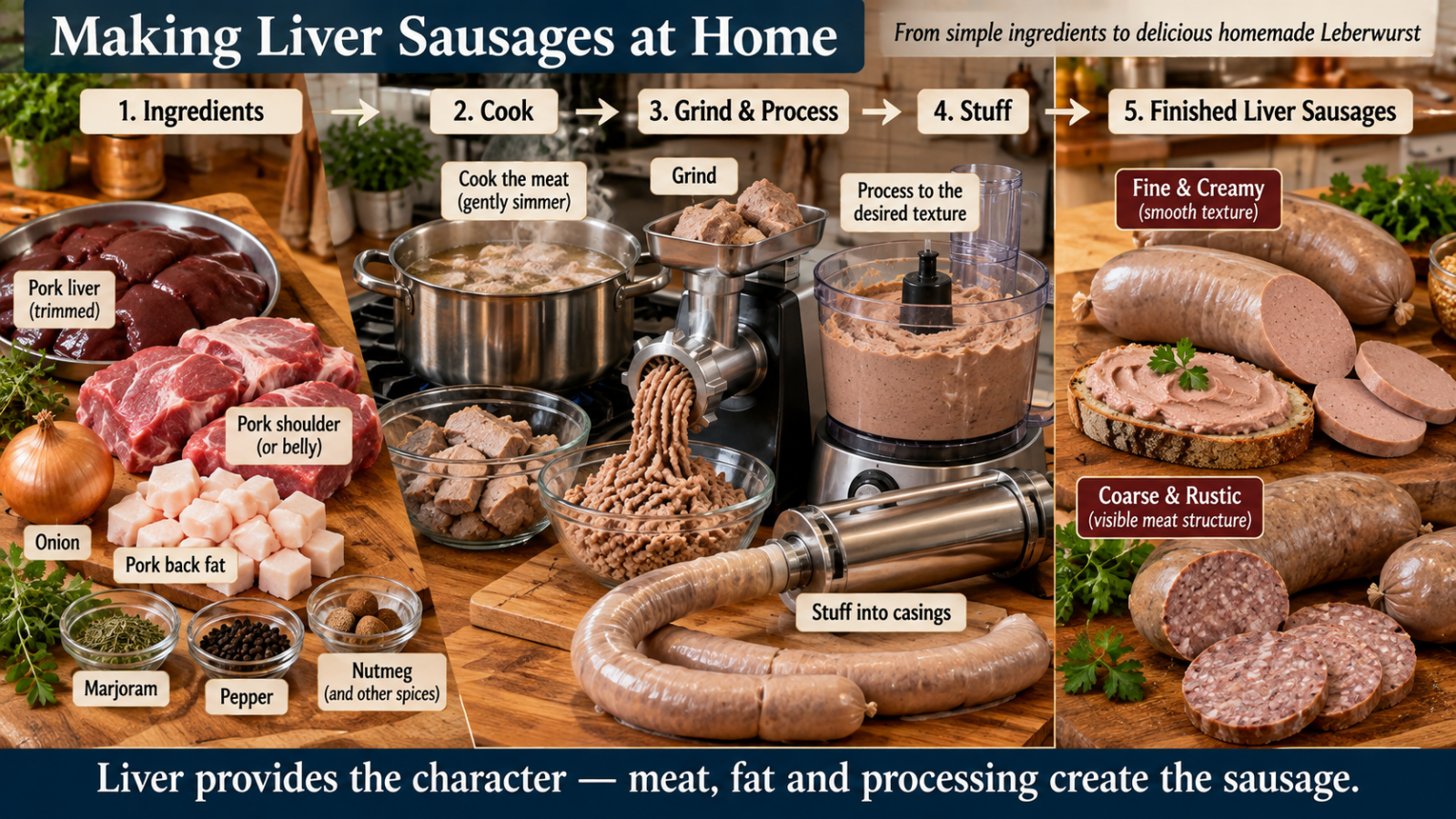
A meat grinder, a food processor for finer varieties, a suitable cooking pot and some basic sausage-making equipment are enough to make excellent liver sausage at home.
The important part is understanding that liver sausage isn't simply liver that has been ground, seasoned and stuffed into a casing.
Good liver sausage is about balance. Liver provides the character, but meat, fat, seasoning and processing create the sausage.
What Do We Mean by Liver Sausage?
Liver sausage describes a large family of cooked sausages containing liver.
In Germany, Austria and neighbouring parts of Europe you'll encounter numerous versions of Leberwurst, and they can be remarkably different from one another.
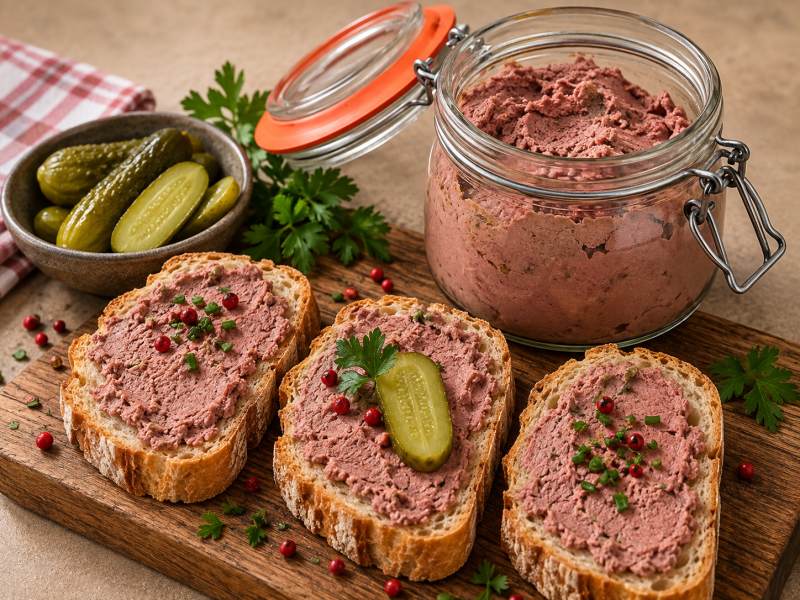
Some are extremely fine, creamy and easily spread on bread. Others are deliberately coarse, with a much more rustic texture.
Seasonings vary from region to region as well. Marjoram and onion are particularly familiar flavours, while pepper, nutmeg, mace, ginger, allspice and other spices appear in different combinations.
There isn't one single formula that defines the perfect liver sausage.
Instead, we can understand the principles and then see how individual recipes use them to create different styles.
Liver Provides the Character
Liver obviously provides the defining flavour, but it also contributes considerably to the structure of the sausage.
That doesn't mean that more liver automatically produces better Leberwurst.
Too little and the characteristic liver flavour can disappear. Too much can produce a flavour that is considerably stronger than intended and can change the texture as well.
The correct proportion therefore depends on the style of liver sausage being made.
For that reason, follow the quantity specified by a tested recipe rather than simply adding extra liver because you happen to have some left.
Which Liver Should We Use?
Pork liver is a classic choice for many traditional European liver sausages. It has a pronounced flavour and works particularly well with pork meat and fat.
Other liver can also be used where the recipe is designed for it.
Calf or beef liver gives a somewhat different character, while chicken liver can produce an especially delicate and creamy result.
Whatever type you're using, start with fresh liver from a reliable source.
Trim away obvious connective tissue, blood vessels and other unwanted tissue according to the recipe before processing.
Meat and Fat Are Just as Important
One of the biggest misconceptions about liver sausage is that it consists mainly of liver.
In many recipes, liver is only one part of the mixture.
Pork shoulder, pork belly, jowl and back fat are commonly used to provide body, richness and the characteristic soft texture.
Fat is particularly important.
If we make a liver sausage excessively lean, the result can be dry, crumbly and disappointing rather than rich and spreadable.
As with other sausages, however, the correct balance should come from the recipe rather than guesswork.
Why Is Some of the Meat Cooked First?
This is one of the biggest differences you'll notice when moving from fresh sausage making to liver sausage.
Many liver-sausage recipes partially or fully cook the pork meat and fatty components before grinding and mixing.
The exact method varies considerably between styles.
You may see pork belly or other meat gently simmered or poached until cooked or nearly cooked, while the liver is handled separately and incorporated later.
Other recipes use a different sequence.
This isn't an unnecessary complication. The cooking method helps create the characteristic texture of that particular liver sausage.
Follow the sequence specified in the recipe rather than assuming that liver, meat and fat should all be treated identically.
Don't Throw Away the Cooking Liquid
If a recipe asks us to simmer pork before making the sausage, the cooking liquid can become a useful ingredient.
It contains flavour as well as dissolved proteins and gelatin from the meat.
A measured amount may be incorporated into the sausage mixture to help produce the intended consistency.
This is another reason not to improvise quantities. Too much liquid can make the mixture excessively soft, while too little may produce a firmer sausage than intended.
Liver Sausage Breaks Some of Our Usual Rules
If you've followed Dieter's Sausage Kitchen for a while, you've repeatedly heard me say:
Keep everything cold.
That's extremely important when making fresh sausages and fine emulsified sausages because we want to prevent fat smearing and maintain a stable meat-and-fat mixture.
Liver sausage can be different.
Some traditional methods deliberately process pre-cooked meat and fat while they're still warm because this assists the development of the desired soft consistency.
That does not mean we can simply leave liver and meat sitting around in a warm kitchen.
It means that temperature management is part of the particular liver-sausage process.
If the recipe calls for warm processing, work efficiently and follow that method. If it calls for chilled ingredients, keep them chilled.
Don't automatically transfer the processing rules from fresh Bratwurst to Leberwurst — or vice versa.
Coarse or Fine?
This is where making liver sausage becomes particularly interesting.
By changing the way we process the ingredients, we can produce dramatically different sausages from similar basic ingredients.
Coarse Liver Sausage
For a rustic liver sausage, the cooked meat and fat may simply be passed through an appropriately sized grinder plate.
The liver can be ground more finely and mixed into the coarser meat mixture.
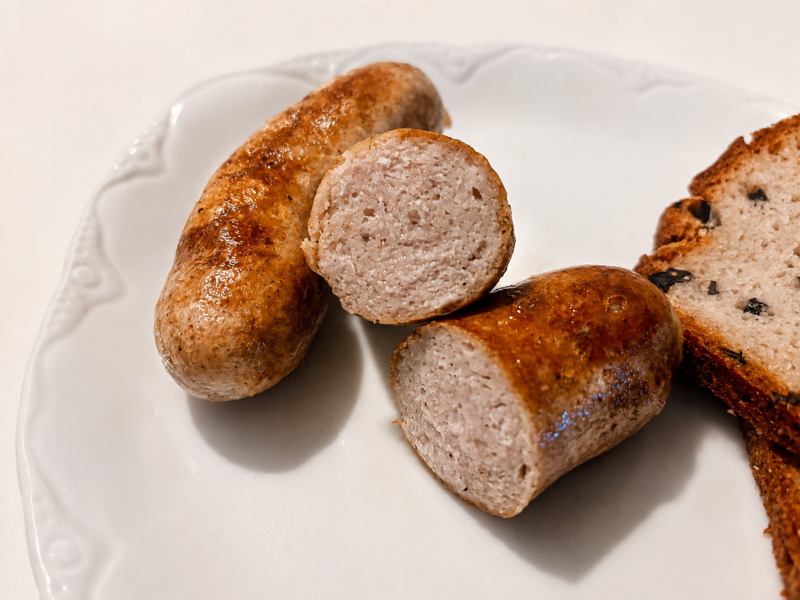
The finished sausage retains visible structure and has a hearty, traditional character.
Fine Liver Sausage
For a creamy spreadable Leberwurst, we need much finer processing.
A professional butcher would traditionally use specialised cutting or emulsifying equipment.
At home, a good food processor can do an excellent job with suitably sized batches.
The mixture is processed until the desired smooth consistency is achieved.
This is another good example of why we don't need to recreate a butcher's shop in our kitchen.
Using a Food Processor
If you're making a fine liver sausage, don't overload the food processor.
Working in manageable batches generally produces a more even result and places less strain on the machine.
Scrape down the sides when necessary so everything is processed evenly.
Depending on the recipe, the liver may be processed separately before being combined with the meat and fat.
The objective isn't simply to run the machine for as long as possible. We're trying to produce the texture specified by the recipe without unnecessarily abusing the mixture or the equipment.
The Importance of Onions
Onion appears in countless liver-sausage recipes and makes a considerable contribution to the finished flavour.
It may be gently cooked in fat until soft, cooked with the meat, or handled another way depending on the recipe.
Raw and cooked onion don't produce the same flavour, so don't casually substitute one preparation for another.
Gently cooked onion contributes sweetness and depth that works particularly well with liver.
Classic Liver-Sausage Seasonings
Liver works extremely well with warm, aromatic spices.
Depending on the regional style, you may encounter:
- Marjoram
- Black pepper
- White pepper
- Nutmeg
- Mace
- Allspice
- Ginger
- Cardamom
- Onion
Marjoram is particularly strongly associated with many German liver sausages.
The objective isn't necessarily to taste each spice individually. In a well-balanced Leberwurst, the seasonings support the liver and pork rather than compete with them.
Ordinary Salt or Curing Salt?
You'll find liver-sausage recipes using ordinary salt and others using nitrite curing salt.
They aren't automatically interchangeable.
Nitrite curing salt can contribute the familiar cured colour and flavour of certain sausage styles as well as performing its technological curing function.
If a recipe specifies curing salt, use the exact type and quantity for which that recipe was designed.
This is especially important internationally.
European Nitritpökelsalz is a premixed curing salt containing a relatively small percentage of sodium nitrite, while American Cure #1 is a much more concentrated curing mixture.
They must never simply be substituted gram for gram.
If a recipe provides alternatives for different curing systems, follow the appropriate formulation exactly. Otherwise, don't attempt to calculate a substitution by guesswork.
Stuffing Liver Sausage
Liver sausage can be filled into various casings depending on the style.
Natural casings are suitable for many varieties, while larger artificial casings are often convenient for smooth spreadable sausages.
Because fine liver-sausage mixtures can be considerably softer than ordinary Bratwurst meat, stuffing feels a little different.
Fill steadily and evenly without unnecessarily trapping air.
Don't overfill the casing. The sausage still has to survive its final cooking step without splitting.
What About Jars?
Some traditional liver sausages are also prepared in preserving jars.
That's a useful method, but it shouldn't be treated as simply another type of casing.
Preserving meat in sealed jars introduces specific processing and food-safety requirements.
If we make a jar-preserved liver sausage, we should therefore use a recipe and preservation process specifically designed and validated for that method rather than stuffing an ordinary sausage recipe into jars and improvising the processing time.
Cooking the Stuffed Sausages
Most liver sausages of the type we're discussing are cooked products.
They're generally heated gently rather than subjected to a vigorous boil.
Boiling can place unnecessary stress on the casing and can also negatively affect the texture and encourage fat separation.
The exact water temperature, cooking time and required internal temperature depend on the formulation, casing diameter and cooking process specified by the recipe.
Use a reliable food thermometer rather than judging safety from colour or texture alone.
Internal Temperature and Food Safety
For home cooking, current USDA food-safety guidance recommends that ground beef, pork, lamb and veal reach at least 71°C (160°F) internally.
Products containing ground poultry should reach at least 74°C (165°F).
If a validated recipe specifies a particular time-and-temperature cooking process, follow that process in its entirety.
Remember that the temperature of the poaching water and the internal temperature of the sausage are two different measurements.
Cool the Sausages Properly
Once the required cooking process is complete, the sausages should be cooled promptly.
Cold-water cooling can help stop the cooking process and bring the temperature down quickly before refrigeration.
After cooling, allow the casings to dry as appropriate and refrigerate the sausages promptly.
Cooked liver sausage is still a perishable meat product.
Why Did My Liver Sausage Turn Out Dry?
A dry or crumbly liver sausage can have several causes.
The formulation may have contained insufficient fat, too much moisture may have been lost during cooking, or the recipe may simply have been altered too far from its intended balance.
Remember that the richness of good Leberwurst comes partly from fat.
Trying to turn a traditional liver sausage into an extremely lean product can fundamentally change its texture.
Why Is It Greasy?
Visible pockets of separated fat usually indicate that the mixture hasn't remained properly bound during processing or cooking.
Possible causes include unsuitable processing, poor emulsification in a fine sausage, or excessive heat during cooking.
A little visible fat in a deliberately coarse rustic sausage isn't necessarily a defect. A pool of rendered fat surrounding a supposedly creamy liver sausage is another matter.
Why Is the Texture Grainy?
If a fine liver sausage feels grainy rather than creamy, consider how thoroughly the ingredients were processed and whether the method and temperatures specified by the recipe were followed.
Fine liver sausage depends on more than simply using a small grinder plate.
Grinding makes particles smaller. Creating a truly smooth sausage may require further processing in a food processor or cutter.
Why Does It Taste Too Strongly of Liver?
Some people love an assertive liver flavour; others prefer something considerably milder.
The type of liver, proportion used, seasoning and amount of pork and fat all influence the result.
If you're developing your own variation, it's generally better to begin with a balanced established formulation and make small adjustments rather than dramatically increasing or decreasing the liver.
Hygiene Is Particularly Important
Raw liver and meat should be handled with the same careful hygiene we use throughout sausage making.
Keep raw ingredients away from cooked and ready-to-eat foods, wash hands and utensils thoroughly, clean work surfaces and avoid cross-contamination.
Once the sausages have been fully cooked, don't put them back onto trays or surfaces that previously held the raw product.
Refrigeration and Storage
Homemade cooked liver sausage should be treated as a refrigerated perishable food unless you're following a separately validated preservation process.
Cool it promptly and keep it refrigerated at 4°C (40°F) or below.
If you aren't going to use it within the storage period specified by your recipe or applicable food-safety guidance, freezing is a practical option for many liver sausages.
Freezing may cause a slight change in texture in particularly delicate emulsified varieties, but it works very well for many homemade products.
Start with a Simple Liver Sausage
If you've never made liver sausage before, don't begin by trying to reproduce the most complicated delicatessen product you can find.
A straightforward cooked Leberwurst teaches you nearly everything you need to understand:
- Preparing the liver
- Cooking the meat and fat
- Grinding
- Balancing liver, meat and fat
- Seasoning
- Stuffing a soft mixture
- Gentle final cooking
- Cooling
Once you've mastered those principles, moving between coarse country-style Leberwurst and smooth spreadable varieties becomes much easier.
Different Styles, Same Basic Principles
| Style | Typical Character |
|---|---|
| Fine liver sausage | Smooth, creamy and spreadable |
| Coarse liver sausage | Rustic with a clearly visible meat and fat structure |
| Bierleberwurst | Rich and spreadable with a subtle malty character |
| Calf-liver style | Fine, delicate and comparatively mild |
| Country-style liver sausage | Hearty, coarser and usually more strongly seasoned |
You Don't Need Professional Equipment
Making liver sausage is another good example of the philosophy behind Dieter's Sausage Kitchen.
A butcher may have a large commercial grinder, industrial bowl cutter, hydraulic stuffer and temperature-controlled cooking equipment.
At home, we can work on a much smaller scale.
A kitchen meat grinder handles the coarse work. A domestic food processor can produce surprisingly fine mixtures. A simple sausage stuffer or suitable attachment fills the casings, and an ordinary cooking pot with an accurate thermometer handles the final cooking.
Understanding what each stage is trying to accomplish matters much more than owning professional machinery.
The Most Important Lesson
Don't think of liver sausage as a sausage made from liver.
Think of it as a carefully balanced mixture in which liver, meat, fat and seasoning each have a particular job.
Once you understand that balance — and understand why the ingredients are cooked, ground and processed in a particular sequence — Leberwurst stops being mysterious.
Good liver sausage is about balance. Liver provides the character, but meat, fat, seasoning and processing create the sausage.
Dieter's Tip: If this is your first liver sausage, don't concentrate on making it as fine as possible. Concentrate on following the recipe's sequence correctly. Learn how the cooked meat, fat and liver behave during grinding and mixing. Once you understand the mixture, achieving either a rustic coarse texture or a silky fine Leberwurst becomes much easier.