For someone making fermented sausage for the first time, the process can seem slightly mysterious.
You mix raw meat and fat with salt, cure, seasoning, a small amount of sugar and a starter culture. The sausages are stuffed and then held under controlled conditions before drying.
During that time something important is happening inside the sausage.
Fermentation.
Fermentation contributes to the familiar tangy flavour, colour and texture of many salamis and other dry sausages, but its role goes much further than flavour.
It is one part of a carefully controlled preservation system.
For the home sausage maker, that means fermentation shouldn't be treated as simply hanging sausages somewhere warm and waiting for them to become sour.
Fortunately, you don't need a professional sausage factory to ferment sausages successfully. With a reliable recipe, commercial starter culture, suitable curing ingredients, controlled conditions and the ability to measure what is happening, fermentation can be approached systematically in the home kitchen.
What Is Sausage Fermentation?
At its simplest, sausage fermentation uses beneficial bacteria to convert fermentable sugars in the sausage mixture into acids, particularly lactic acid.
As acid is produced, the pH of the sausage falls.
This change contributes to several characteristics we associate with fermented sausage:
- The familiar slightly tangy flavour
- Changes in texture
- Development of characteristic cured colour
- Suppression of undesirable microorganisms as part of the overall preservation process
The bacteria aren't an accidental visitor.
For predictable home production, we deliberately introduce selected bacteria using a commercial sausage starter culture.
What Is a Starter Culture?
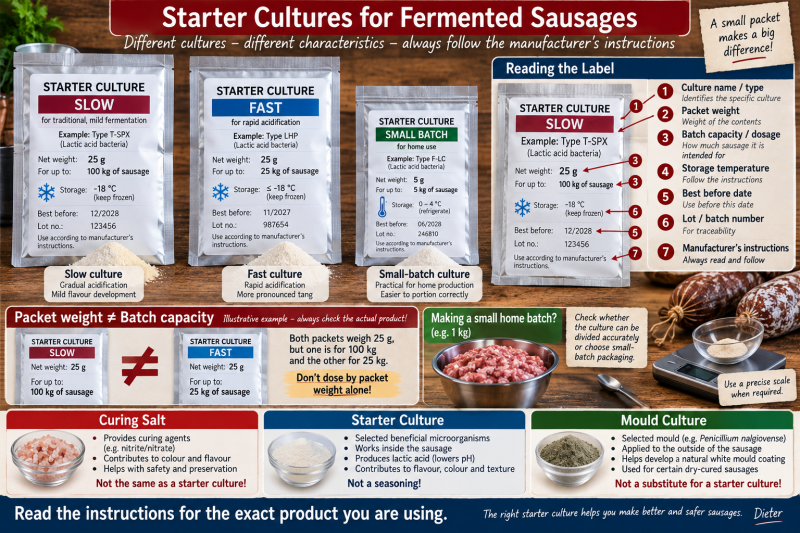
A starter culture is a prepared mixture containing selected microorganisms intended to produce a predictable fermentation.
Different cultures are designed for different sausage styles and fermentation conditions.
Some are intended for relatively mild, slow fermentation, while others can produce a faster and more pronounced acidification.
That means starter cultures aren't simply interchangeable packets of "salami bacteria."
Choose the culture required by the recipe and follow the manufacturer's instructions for that particular product.
Why Not Rely on Naturally Occurring Bacteria?
Historically, many sausages were fermented using microorganisms naturally present in the meat, equipment and surrounding environment.
Experienced producers developed successful processes around their particular recipes and conditions.
For a beginner making fermented sausage at home, relying on whatever microorganisms happen to be present introduces unnecessary uncertainty.
A commercial starter culture introduces known desirable organisms in sufficient numbers to establish themselves quickly.
This makes the fermentation much more predictable.
For home production, that's exactly what we want.
What Does Sugar Do?
You'll often find a small amount of sugar in fermented sausage recipes even when the finished sausage doesn't taste sweet.
That sugar has an important job.
It provides fermentable carbohydrate that the starter bacteria can use to produce acid.
The type and quantity of sugar influence fermentation and therefore shouldn't be casually removed, doubled or replaced simply because you prefer a sweeter or less sweet sausage.
In a fresh sausage, adjusting sugar is primarily a flavour decision.
In a fermented sausage, it can be part of the process design.
Understanding pH
You'll encounter the letters pH repeatedly when learning about fermented sausages.
pH is a measure of acidity.
The scale runs from 0 to 14, with lower numbers representing more acidic conditions.
Fresh meat normally begins well above the acidity eventually reached by many fermented sausages.
As the starter culture produces acid, the pH falls.
This is one of the changes that helps make conditions less favourable for certain undesirable microorganisms.
But there isn't one universal final pH that you should apply to every fermented sausage.
The required pH and the time in which it must be reached belong to the particular recipe and process you're following.
Measure pH — Don't Taste for It
A sausage becoming tangy tells you that acid has developed.
It doesn't tell you accurately what the pH is.
For controlled fermentation, use an appropriate calibrated pH meter when the process requires pH verification.
Test according to the meter manufacturer's instructions and the procedure specified for the sausage you're making.
Test strips may look inexpensive and convenient, but meat is a difficult material for precise colour comparison and a suitable pH meter gives much more useful information.
Your tongue isn't a pH meter.
Temperature Controls the Fermentation
Starter cultures contain living microorganisms, and their activity is strongly influenced by temperature.
Too cold and the culture may work much more slowly than intended.
Too warm and you may create conditions outside those for which the process was designed.
Different commercial cultures are designed to operate under different conditions.
That's why I'm deliberately not giving you a single fermentation temperature here.
Use the temperature specified by the recipe and the manufacturer of the starter culture you're using.
Humidity Matters Too
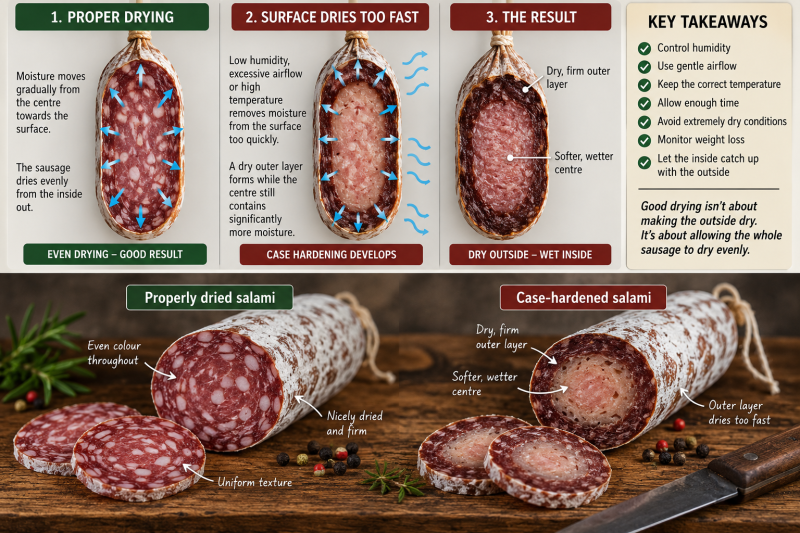
During fermentation, we don't want the outside of the sausage drying rapidly while the fermentation is still taking place.
The sausage needs an appropriate environment for the particular process.
Humidity therefore forms part of the fermentation conditions and later becomes particularly important during drying.
As we saw in our article about case hardening, removing moisture from the surface too quickly can create a dry outer layer around a wetter centre.
Fermentation and drying are connected stages, but they aren't the same thing.
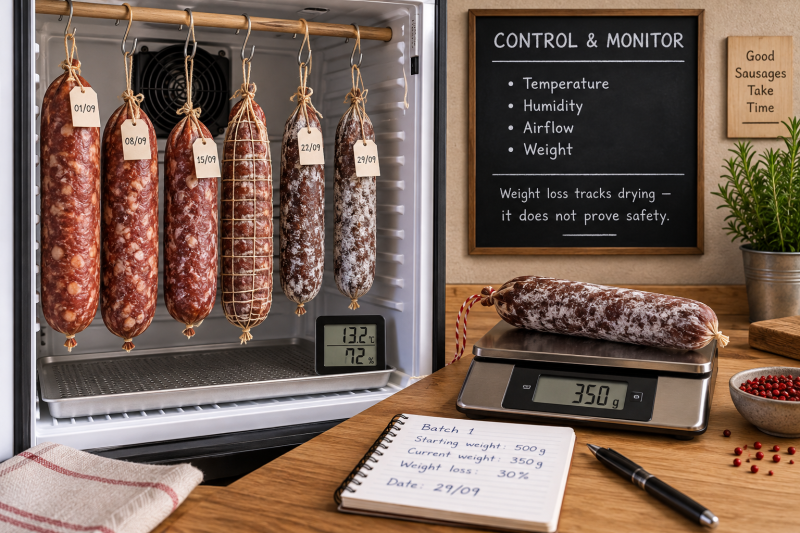
A Simple Home Fermentation Chamber
You don't necessarily need expensive commercial equipment to provide controlled fermentation conditions.
A small insulated cabinet, temperature-controlled chamber or appropriately configured food-safe enclosure may be suitable for home use if it can maintain the conditions required by your recipe.
Depending on the process, you may need:
- A reliable temperature controller
- A separate thermometer to verify the actual temperature
- A hygrometer for relative humidity
- A safe method of providing or controlling humidity where required
- Enough space to keep sausages separated
What matters isn't how sophisticated the chamber looks.
What matters is whether you can reliably produce and verify the conditions required by the process.
Don't Use the Kitchen Oven as a Guessing Box
You'll sometimes see suggestions to put sausages into an oven with the light switched on or use another warm corner of the house.
The problem isn't that simple equipment can never work.
The problem is using an environment without knowing what conditions it is actually producing.
An oven light can generate very different temperatures in different ovens.
A cupboard, utility room or warm kitchen can change considerably during the day.
If you use simple equipment, measure and control it.
Don't assume.
Fermentation Isn't the Same as Spoilage
Fermentation is controlled microbial activity produced by organisms we deliberately want in the sausage.
Spoilage is uncontrolled.
A bad smell, slime, unexpected discolouration or other abnormal development shouldn't be dismissed as "probably just fermentation."
When a raw meat fermentation behaves substantially differently from the validated process you're following, don't taste the sausage to investigate.
Fermentation Doesn't Make Every Sausage Shelf-Stable
This is an extremely important distinction.
A successfully fermented sausage isn't automatically a finished shelf-stable sausage.
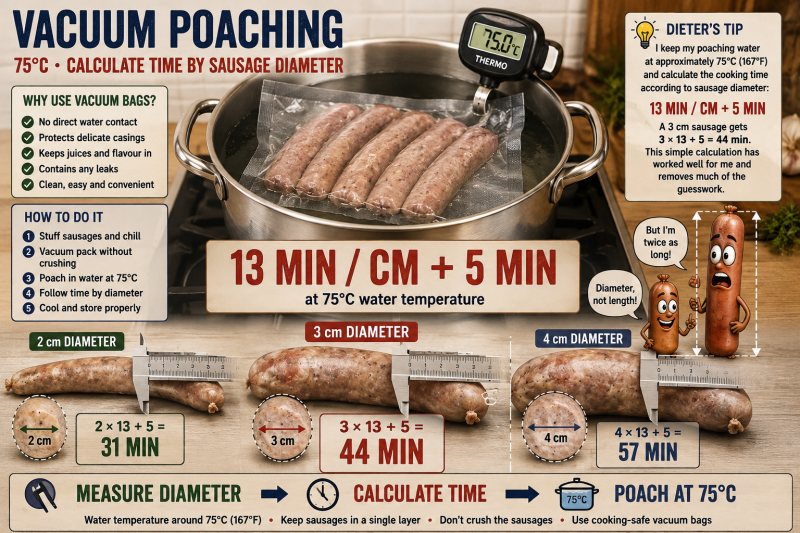
Many products still require further controlled processing, which may include drying, smoking, heating or a combination of steps depending on the sausage.
Fermentation establishes one hurdle.
Other hurdles may include:
- Salt
- Curing ingredients
- Reduced pH
- Heat treatment where required
- Controlled drying
- Reduced water activity
Safety comes from the complete process, not from one successful step.
Fermentation and Drying Do Different Jobs
This distinction is useful for beginners.
Fermentation primarily changes acidity.
Drying primarily removes moisture and reduces water availability.
In many traditional dry sausages, these processes work together.
A sausage can therefore reach its intended fermentation endpoint while still containing far too much available moisture to be considered finished.
That's why our previous articles on drying and case hardening remain important once fermentation is complete.
Starter Culture Doesn't Replace Curing Salt
A starter culture and curing salt perform different functions.
Don't assume that because you're using a starter culture you can omit the curing ingredients specified by the recipe.
Likewise, curing salt doesn't replace controlled fermentation where fermentation forms part of the process.
We've already covered curing products in detail in our article Understanding Curing Salts.
Remember that curing salts sold in different countries can contain very different concentrations of nitrite and nitrate.
Use the exact product type and concentration required by your recipe rather than substituting one curing salt gram for gram with another.
Keep Everything Cold Before Fermentation
Controlled fermentation begins only after the sausage mixture has been prepared and stuffed.
Until then, our normal sausage-making temperature rules still apply.
Keep the meat and fat properly chilled during cutting, grinding, mixing and stuffing.
Don't allow the sausage mixture to warm unnecessarily because you know it will later enter a warmer fermentation environment.
The fermentation stage begins under controlled conditions after stuffing — not accidentally on the kitchen worktop.
Record What You Do
A notebook may be one of the most useful pieces of equipment in fermented sausage making.
For each batch, record information such as:
- The recipe used
- Starter culture and batch details
- Curing product used
- Starting time
- Fermentation temperature
- Humidity where relevant
- Starting pH
- Measured pH during or after fermentation as required
- Time the required fermentation endpoint was reached
When the sausages move into drying, continue recording their weights and chamber conditions.
This turns sausage making from guesswork into a repeatable process.
Start With a Proven Recipe
Fermented sausage isn't the place to design your first recipe from scratch.
Choose a reliable recipe that specifies:
- The meat and fat formulation
- Salt
- The appropriate curing product
- Starter culture
- Fermentable sugar
- Fermentation conditions
- A measurable fermentation endpoint
- Any subsequent cooking, smoking or drying stages
- The required final product endpoint
Follow that process accurately for your first batches.
There's plenty of room for creativity in sausage making, but first understand which ingredients and process steps are there for flavour and which ones are there for safety.
A Good Beginner Setup Doesn't Need to Be Expensive
For home production, I'd rather see a beginner using a small, inexpensive chamber with a reliable controller, thermometer, hygrometer and suitable pH meter than an elaborate curing cabinet whose conditions are never checked.
The principle behind Dieter's Sausage Kitchen still applies here:
You don't need a butcher's shop.
But when we're working with fermented raw meat, simple equipment still needs to give us proper control and useful measurements.
Fermentation Should Be Predictable
The word fermentation sometimes makes the process sound as though we're simply allowing nature to take over.
That's not what we're trying to achieve.
For safe home sausage making, we want the opposite.
We select the culture. We follow a proven formulation. We control the environment. We measure the result. And then we continue with the remaining processing steps required by that particular sausage.
Good fermentation isn't about hoping the right bacteria win.
It's about creating a controlled process in which we deliberately give them the advantage.
Dieter's Tip: For your first fermented sausage, don't start by asking how you can modify the recipe. Make one proven recipe exactly as intended and record everything—culture, temperature, time and pH. Once you've actually watched a fermentation develop and measured the pH change yourself, the whole process becomes much easier to understand.