When we dry sausages, faster isn't necessarily better.
It might seem logical that strong airflow and very dry conditions would help a sausage dry more efficiently. After all, the purpose of drying is to remove moisture.
But sausages need to lose that moisture gradually.
If the surface dries considerably faster than moisture can move from the centre of the sausage towards the outside, a firm, dry layer can develop around a much wetter centre.
This problem is commonly known as case hardening.
It is one of the most important drying problems for anyone moving from fresh and cooked sausages into dry-cured sausage making.
What Is Case Hardening?
A freshly stuffed sausage contains moisture throughout its interior.
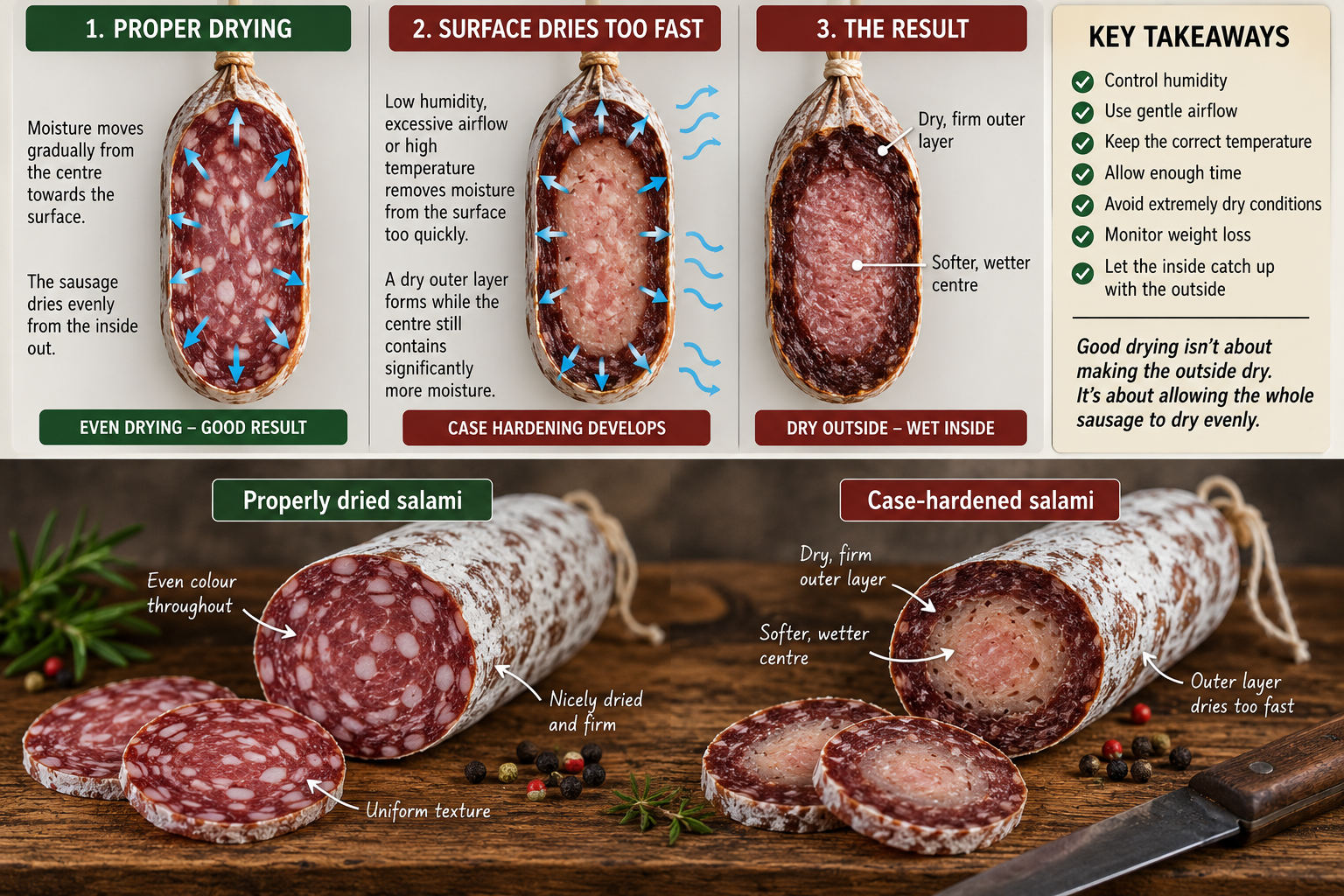
During proper drying, moisture gradually moves from the wetter centre towards the surface. From there, it evaporates into the surrounding air.
Ideally, these two processes remain reasonably balanced:
Moisture moves towards the surface → moisture leaves the surface → the sausage gradually dries throughout.
Case hardening occurs when moisture is removed from the surface too quickly.
The outer portion becomes increasingly dry and firm while the centre still contains considerably more moisture.
As that dry outer layer develops, moisture from the centre may have increasing difficulty moving towards the surface.
The result can be a sausage that feels dry and firm from the outside but is still noticeably softer and wetter when cut open.
Think of Drying From the Inside Out
Although moisture ultimately evaporates from the surface, successful sausage drying depends on moisture being able to travel from the centre towards that surface.
That's why I prefer to think about sausage drying as:
Let the inside catch up with the outside.
We don't want to dry the casing as quickly as possible.
We want the whole sausage to dry progressively and evenly.
What Causes Case Hardening?
Several conditions can make the surface of a sausage lose moisture faster than the interior can replace it.
Humidity Is Too Low
Very dry surrounding air pulls moisture from the sausage surface rapidly.
That might initially produce impressive weight loss, but rapid weight loss isn't necessarily good drying.
If the outside races ahead of the centre, the risk of case hardening increases.
Too Much Airflow
Air circulation is necessary because moisture leaving the sausage needs to be carried away.
But there is an important difference between gentle circulation and a strong stream of air blowing directly across the sausages.
A powerful fan can continuously strip moisture from the surface and cause it to dry too quickly.
For this reason, the goal inside a drying chamber isn't to create a wind tunnel.
Temperature Is Too High
Higher temperatures can accelerate moisture loss and also influence microbial activity.
Drying conditions should therefore follow the requirements of the particular sausage process rather than simply being made warmer to speed things up.
Trying to shorten a drying process with additional heat can create more problems than it solves.
The Sausage Is Large
Diameter matters.
Moisture near the centre of a thick salami has considerably farther to travel before reaching the surface than moisture inside a thin sausage.
This is one reason why larger-diameter dry sausages generally require particularly patient and carefully controlled drying.
What Does Case Hardening Look Like?
You can't always identify case hardening simply by looking at the outside of a sausage.
In fact, that's part of the problem.
The exterior may look excellent.
It can appear nicely dried, evenly coloured and pleasantly firm.
But when the sausage is cut, you may find a distinct difference between the outer portion and the centre.
Typical signs can include:
- A noticeably firm or dry outer ring
- A much softer centre
- An obvious difference in colour between the outside and inside
- An interior that appears considerably wetter than expected
- Uneven texture from the edge towards the centre
A cross-section of the sausage often tells you far more than looking at the casing.
Case Hardening Isn't Just a Texture Problem
An unevenly dried sausage isn't merely disappointing to eat.
The wetter centre can retain conditions very different from those suggested by the dry exterior.
This is particularly important with raw fermented and dry-cured sausages.
A dry exterior doesn't prove that the centre has reached the required endpoint of the process.
As we discussed in our article on drying sausages at home, appearance, firmness and weight loss alone don't establish that a raw dry-cured sausage is safe or shelf-stable.
Weight Loss Can Be Misleading
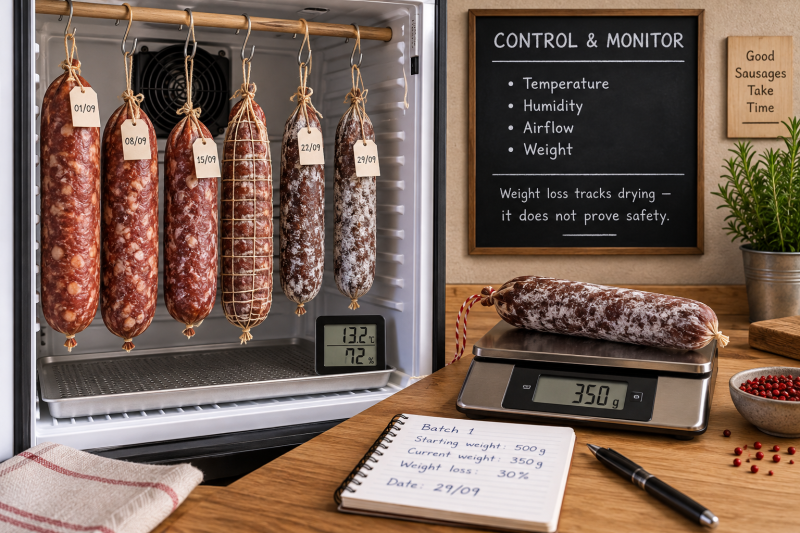
Weighing sausages is extremely useful for monitoring drying progress.
But case hardening illustrates why weight loss needs to be interpreted correctly.
A sausage may lose considerable weight because the outer layers have dried rapidly while moisture distribution inside remains uneven.
So reaching a particular percentage of weight loss doesn't automatically tell you that the sausage has dried evenly.
Weight loss tells us how much weight disappeared. It doesn't tell us exactly where the remaining moisture is located.
How Do We Prevent Case Hardening?
Prevention is much easier than trying to correct a badly case-hardened sausage.
The basic principle is straightforward:
Don't allow the surface to dry dramatically faster than the centre.
Control Humidity
Don't assume that lower humidity always means better drying.
The appropriate relative humidity depends on the sausage and the stage of its particular process.
Follow the drying conditions specified by a reliable recipe or validated process rather than choosing an arbitrary setting.
Use Gentle Air Circulation
Air should circulate throughout the chamber without constantly blasting directly onto the sausages.
If you're using a fan, its purpose is to encourage gentle circulation and reduce stagnant areas—not to blow-dry the sausages.
Keep Sausages Separated
Sausages shouldn't be pressed against each other or against the chamber walls.
Leave enough room for air to circulate around each sausage.
This helps avoid areas that dry very differently from the rest of the surface.
Follow the Correct Temperature
Use the temperature range required by the specific recipe and stage of production.
Don't increase the temperature simply because the sausages appear to be drying slowly.
Be Patient
This may be the simplest advice and sometimes the hardest to follow.
Dry-cured sausage making isn't a process that benefits from being rushed.
If a sausage is intended to dry gradually over an extended period, trying to remove the same moisture in a fraction of that time isn't an improvement.
What If Case Hardening Has Already Started?
If you notice that the surface is becoming excessively firm while the sausage is still clearly early in its drying process, first check the drying environment.
Look at:
- Actual chamber humidity
- Actual chamber temperature
- Airflow around the sausages
- Whether a fan is blowing directly onto them
- Whether the chamber conditions match the recipe you're following
Correcting an environmental problem early may prevent it from becoming worse.
But don't assume that a severely case-hardened raw sausage can always be rescued simply by increasing humidity and waiting longer.
If the product has spent significant time outside the conditions required by its validated process, its safety can't be restored merely by making the outside softer again.
When the safety of a raw preserved meat product is uncertain, don't taste it to find out.
Don't Confuse a Firm Casing With Case Hardening
A properly dried sausage is naturally firmer than a fresh sausage.
The casing and meat immediately underneath it will also usually feel firmer as moisture is lost.
That alone isn't case hardening.
The problem is a pronounced drying gradient—a disproportionately dry outer region surrounding a substantially wetter centre.
What we're trying to achieve is a gradual transition and reasonably even drying throughout the sausage.
Diameter Changes the Drying Challenge
Compare a thin snack sausage with a large salami.
The thin sausage has a relatively short distance between its centre and its surface.
A large salami may have several centimetres of meat between its centre and the surrounding air.
The thicker the sausage, the more important controlled moisture migration becomes.
This is another reason why you shouldn't take the drying schedule for one sausage and automatically apply it to another with a very different diameter.
Your Drying Chamber Is a Control Tool
A home drying chamber doesn't need to resemble professional charcuterie equipment.
A properly configured small chamber can work very well for home production.
What's important is that it allows you to monitor and, where required, control the environment specified by the process.
Temperature, humidity and airflow work together.
Changing one can influence how the others affect the sausage.
Don't Chase Fast Weight Loss
Watching the number on the scale fall can be satisfying.
But the fastest-drying sausage isn't necessarily the best sausage.
With dry-cured products, controlled and even moisture loss is far more important than achieving a particular percentage as quickly as possible.
A successful sausage should develop its texture progressively from the outside towards the centre without creating a hard shell around a wet interior.
The Simple Lesson
Case hardening sounds technical, but the basic concept is easy to remember.
The outside dried faster than the inside could keep up.
Preventing it comes down to controlled conditions, gentle airflow and patience.
Don't try to force moisture out of a sausage.
Create the correct environment and give that moisture time to move naturally from the centre towards the surface.
Good drying isn't about making the outside dry. It's about allowing the whole sausage to dry evenly.
Dieter's Tip: Don't judge drying progress only by squeezing the sausage. A firm exterior can give you a false sense that everything inside is progressing equally well. Keep records of chamber conditions and weight, follow the process for that particular sausage, and remember: with drying, faster is rarely better.