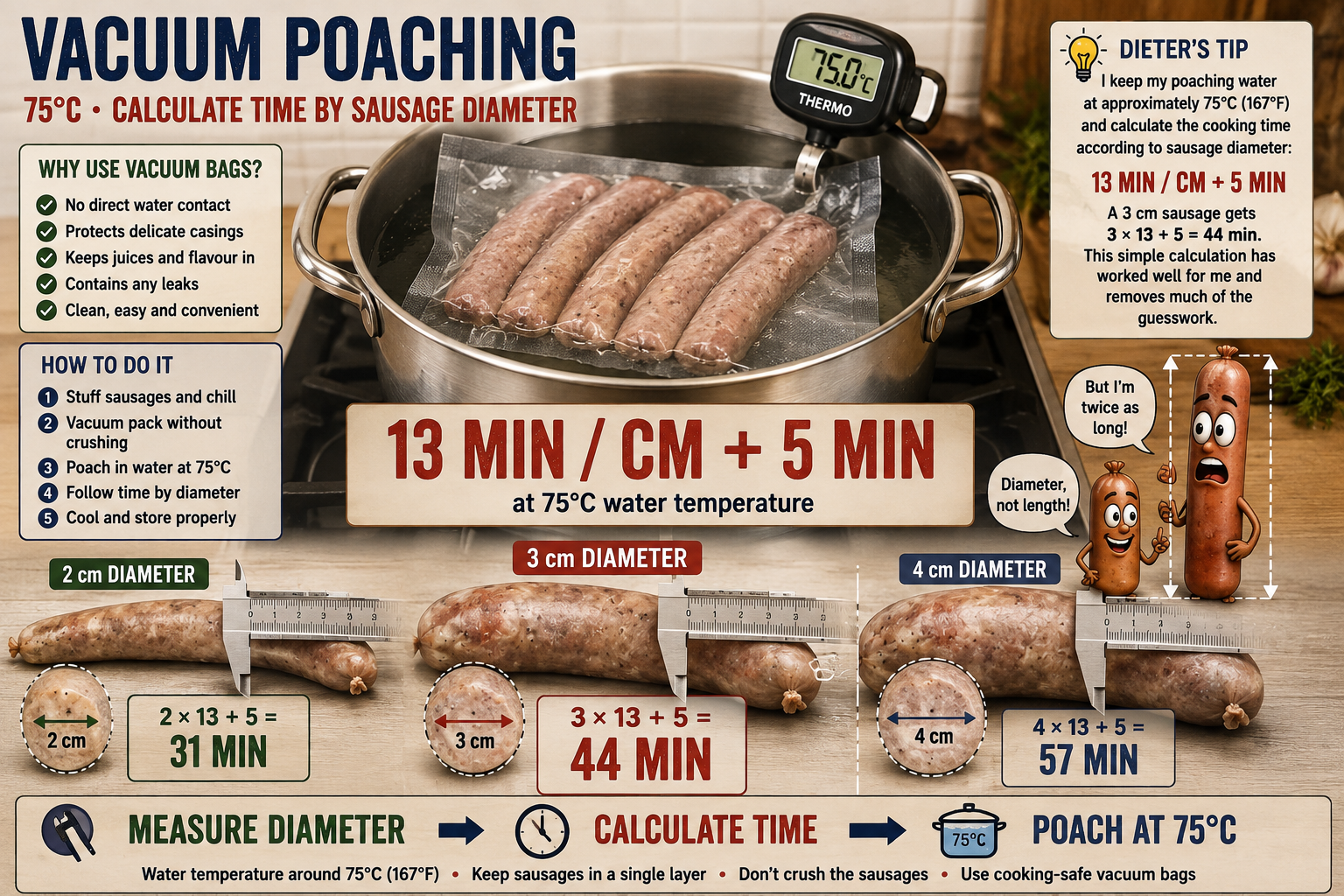
Most of the time when we talk about poaching sausages, we picture them floating directly in a pot of hot water.
That method works perfectly well, and I use it regularly.
But there's another technique that's particularly useful for certain sausages: poaching them inside a vacuum bag.
The sausages are sealed in a heat-suitable vacuum bag and the entire package is submerged in temperature-controlled hot water.
The sausages still cook through gentle heat, but they never come into direct contact with the poaching water.
Why Poach Sausages in a Vacuum Bag?
Vacuum-bag poaching has several practical advantages.
The bag keeps the sausages together and protected while they cook. Any juices or fat released from the sausages remain inside the package rather than disappearing into the poaching water.
It can also be particularly useful for delicate sausages or products where you want to minimise handling during cooking.
And if a casing happens to develop a small split, the contents remain contained inside the bag rather than escaping into the pot.
This Isn't Necessarily Sous Vide
Because we're using a vacuum bag and temperature-controlled water, it's tempting to call the technique sous vide.
There is certainly some overlap in equipment and principle, but that's not necessarily what we're doing here.
For our purposes, the vacuum bag is primarily a convenient and protective way of poaching the sausage.
We're still cooking the sausage according to the requirements of the particular recipe and checking that the appropriate internal temperature has been reached.
Use Bags Intended for Cooking
Don't use an ordinary food-storage bag simply because it can be vacuum sealed.
Use vacuum bags specifically intended by the manufacturer for cooking at the temperatures you plan to use.
The bag needs to tolerate prolonged contact with hot water without weakening, opening or becoming unsuitable for food contact.
Let the Sausages Rest Before Packing
Freshly stuffed sausages often benefit from some time in the refrigerator before further processing.
This allows the filling to settle and the casing surface to dry slightly.
Follow the resting period specified by the recipe before vacuum packing.
Don't Crush the Sausages
This is one of the most important practical considerations.
A powerful vacuum can compress soft, freshly stuffed sausages, flatten their shape or put unnecessary pressure on the casings.
Arrange the sausages in the bag in a single layer wherever practical and leave enough room between them for the bag to conform naturally around the links.
If your vacuum sealer allows you to control the vacuum manually, stop once most of the air has been removed and the bag has settled around the sausages.
The objective is to remove excess air and seal the package—not to squeeze the sausages as hard as possible.
Don't Overfill the Bag
A large pile of sausages packed tightly together will heat less evenly than sausages arranged in a relatively flat layer.
For larger batches, use several bags rather than forcing everything into one.
This also makes the packages easier to handle and cool afterwards.
Make Sure the Seal Is Secure
Before the bag goes anywhere near the water, inspect the seal.
Moisture, fat or sausage mixture around the sealing area can prevent a reliable seal.
Keep the top of the bag clean and dry while loading it.
If your machine and bags permit it, a second seal above the first can provide additional security for cooking applications.
Prepare the Poaching Water
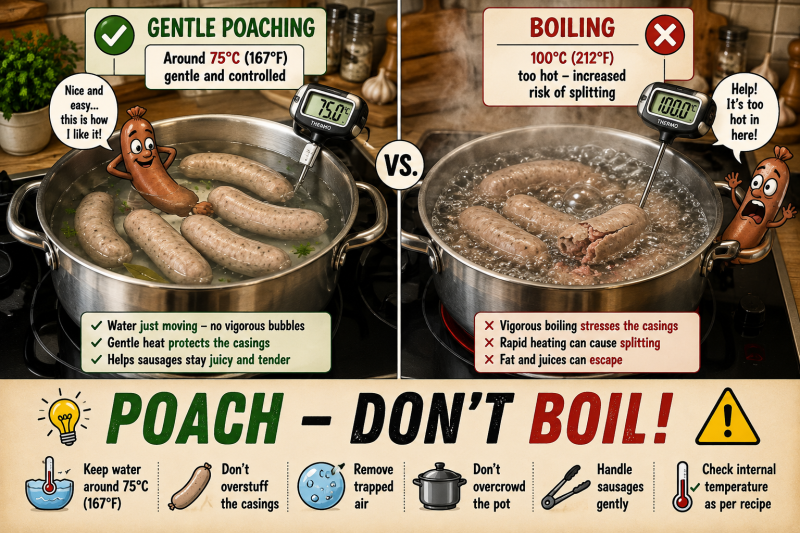
As with ordinary sausage poaching, we're looking for gentle, controlled heat rather than boiling water.
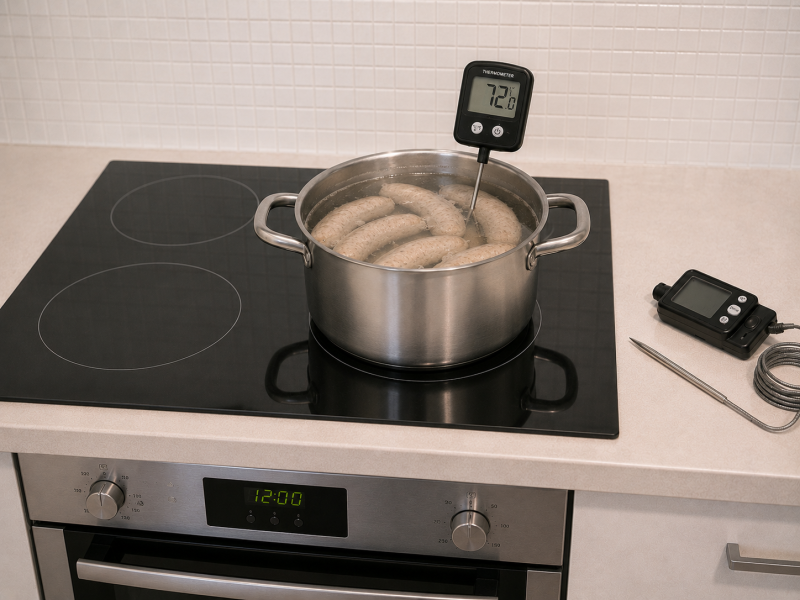
For many of my poached sausages, I aim for water around 75°C (167°F), unless the particular recipe specifies otherwise.
Use a thermometer to monitor the water rather than judging the temperature by appearance.
Submerge the Bag
Place the sealed package gently into the prepared water.
The sausages should be surrounded by hot water so that heat can transfer evenly through the bag.
If a package tends to float because some air remains inside, use a suitable heat-resistant rack or weight to keep it submerged without crushing the sausages.
Don't tightly pack the pot with bags. Water needs room to circulate around them.
Expect the Water Temperature to Drop
Cold sausages entering the pot will absorb heat, so the water temperature will initially fall.
That's normal.
Allow the temperature to recover gradually and adjust the heat as necessary.
Don't respond by turning the hob to maximum and accidentally sending the water towards boiling.
Gentle temperature recovery is exactly what we want.
How Long Do I Poach Vacuum-Packed Sausages?
With vacuum-bag poaching, I use a simple rule based on the diameter of the sausage.
At a controlled water temperature of approximately 75°C (167°F), the method that works reliably for me is:
13 minutes per centimetre of sausage diameter + 5 minutes
So, for example, a sausage measuring approximately 3 cm in diameter would be calculated as:
3 × 13 minutes + 5 minutes = 44 minutes
The important measurement here is the diameter of the sausage, not its length. A longer sausage of the same diameter doesn't necessarily require a longer poaching time because the heat still has approximately the same distance to travel to reach the centre.
Using this method gives the following practical guide:
| Sausage Diameter | Calculation | Poaching Time at 75°C |
|---|---|---|
| 2 cm | 2 × 13 + 5 | 31 minutes |
| 2.5 cm | 2.5 × 13 + 5 | 37.5 minutes |
| 3 cm | 3 × 13 + 5 | 44 minutes |
| 3.5 cm | 3.5 × 13 + 5 | 50.5 minutes |
| 4 cm | 4 × 13 + 5 | 57 minutes |
| 5 cm | 5 × 13 + 5 | 70 minutes |
This is the practical method I use in my own kitchen. It assumes that the poaching water is maintained at approximately 75°C and that the sausages are arranged in the vacuum bag so that hot water can circulate around the package.
Remember that sausage composition, starting temperature, equipment and package thickness can influence heating. When food safety requires a particular internal temperature, that requirement still takes priority over a time calculation.
What Happens to the Juices?
You may notice a small amount of liquid inside the bag after cooking.
Some moisture and fat release during heating is normal.
A large quantity of separated fat, however, can indicate that the sausage mixture became too warm during processing or cooking, or that the emulsion or bind wasn't sufficiently stable.
The vacuum bag makes this particularly easy to see because everything that leaves the sausage remains visible inside the package.
Cooling the Sausages
Once the sausages have reached the required internal temperature, remove the bag from the hot water.
If the recipe calls for rapid cooling, cool the sealed package promptly using the method specified in the recipe before transferring it to refrigeration.
Keeping the sausages sealed during initial cooling can make the process particularly clean and convenient.
When Is Vacuum-Bag Poaching Particularly Useful?
I find the method especially interesting for:
- fine and emulsified sausages;
- delicate casings;
- sausages that will be cooled and stored after poaching;
- small batches where precise temperature control is easy;
- and situations where I want to keep any released juices contained.
It isn't necessary for every sausage. Ordinary water poaching remains simple, effective and often quicker to set up.
Think of vacuum-bag poaching as another technique available to you rather than a replacement for conventional poaching.
Vacuum Packing Doesn't Replace Temperature Control
This is perhaps the most important point.
Putting sausages into a vacuum bag doesn't make them automatically safe, and it doesn't compensate for incorrect cooking temperatures.
You still need to control the poaching water, achieve the required internal temperature and cool and store the finished product appropriately.
The bag simply gives us a different environment in which to accomplish that.
Another Useful Tool in the Sausage Kitchen
Vacuum-bag poaching is clean, controlled and surprisingly convenient once you've tried it.
Arrange the sausages carefully, use an appropriate cooking bag, avoid excessive vacuum pressure and keep the water at the temperature required by your recipe.
Most importantly, remember that the same basic principle applies whether the sausage is directly in the water or protected inside a bag:
Poach gently, control the temperature and cook the sausage—not the clock.
Reference: Direct Poaching vs Vacuum-Bag Poaching
| Direct Poaching | Vacuum-Bag Poaching | |
|---|---|---|
| Water contact | Sausages directly in water | No direct contact |
| Casing protection | Normal | Additional protection from handling |
| Released juices | Enter poaching water | Remain inside bag |
| Temperature control | Essential | Essential |
| Internal temperature | Relatively easy to probe | Requires more planning |
| Large batches | Very convenient | May require several bags |
| Equipment | Pot + thermometer | Cooking-safe vacuum bags and sealer in addition |
| Cooling | Sausages cooled directly | Package can initially remain sealed |
Dieter's Tip
Don't try to achieve the strongest possible vacuum around freshly stuffed sausages. You're cooking them in a vacuum bag, not preparing a brick. Remove the excess air, let the bag settle around the sausages and seal it before the vacuum starts noticeably deforming them. I also prefer several smaller, relatively flat bags to one large package packed tightly with sausages.