Look through a selection of sausage recipes and you'll regularly find cold water, ice water, crushed ice or ice flakes among the ingredients.
To someone making sausages for the first time, this can seem a little strange. Why add water to meat when we're trying to make a sausage?
The answer is that water has several useful functions in sausage making, while ice gives us an additional advantage: it helps control temperature at the same time.
Used correctly, water and ice can help us distribute seasonings, develop a good protein bind, maintain juiciness and—particularly when making fine sausages—keep the mixture cold while it's being mechanically processed.
Water Is an Ingredient
The first thing to understand is that water isn't simply something we add because a sausage mixture feels dry.
If a recipe specifies 100 g of water or 200 g of crushed ice, that amount forms part of the formulation just like the meat, fat and seasoning.
It should therefore be weighed or measured accurately.
Adding substantially more water than a recipe was designed to hold can weaken the texture and may eventually result in liquid separating during cooking.
Why Add Water to Sausage?
Water can perform several jobs during sausage making.
It helps distribute salt and seasoning throughout the meat mixture, particularly when you're mixing a larger batch. It also provides moisture that can be retained within the protein structure of a properly mixed sausage.
During mixing, salt helps extract myofibrillar proteins from the meat. As the mixture becomes sticky and cohesive, these proteins contribute to the structure that binds the meat, fat and moisture together.
The result isn't simply a wetter sausage. When the formulation and mixing are correct, the water becomes part of the finished sausage structure.
Cold Water or Ice Water?
For many coarse and medium-ground sausages, very cold water is perfectly suitable.
However, there's little reason to add warm or room-temperature water to meat that we've spent considerable effort keeping cold.
I prefer the water to be as cold as practical. Ice water allows us to introduce the required liquid without unnecessarily raising the temperature of the sausage mixture.
This is particularly useful after grinding, when friction has already added some heat to the meat.
Crushed Ice and Ice Flakes
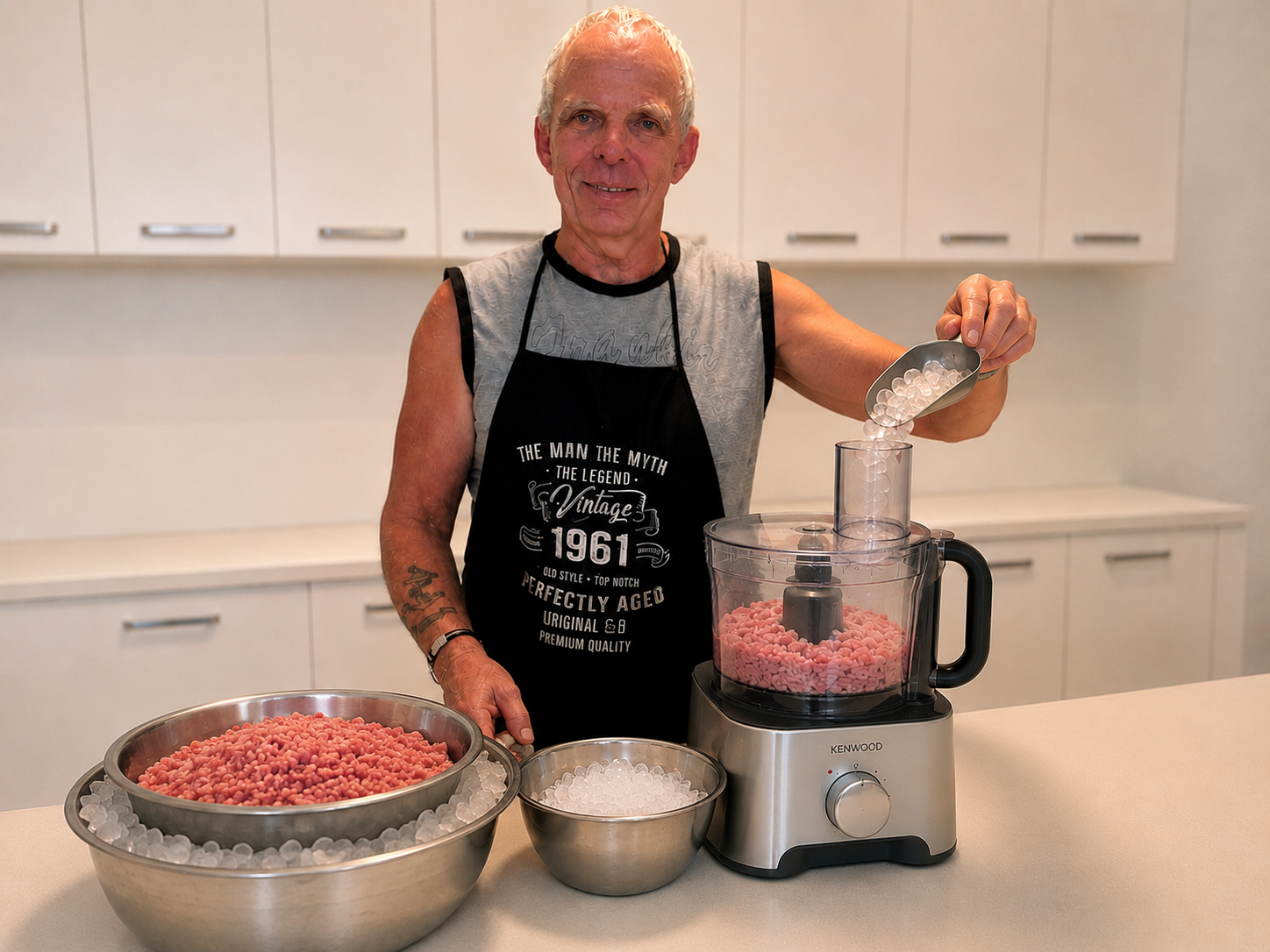
Crushed ice becomes especially useful when making fine and emulsified sausages.
A food processor or bowl cutter generates considerable heat as its blades rapidly process the meat and fat.
Ice absorbs some of that heat as it melts while simultaneously providing the water required by the recipe.
This is why you'll often see crushed ice or ice flakes specified in recipes for Fine Bratwurst, Frankfurters, Lyoner and similar products.
In these recipes, the ice isn't an optional cooling trick. It performs an important role in both the formulation and the processing technique.
Ice Doesn't Replace Proper Chilling
This is an important point.
Adding ice doesn't mean you can begin with warm meat.
Your meat and fat should still be properly chilled before grinding, and your grinder components should be cold whenever practical.
Ice helps us maintain a low temperature during processing. It shouldn't be relied upon to rescue meat that was already too warm when we started.
Why Temperature Matters
Fat behaves very differently when it is cold and firm than when it becomes warm and soft.
During grinding, cold fat cuts cleanly. Warm fat is much more likely to smear.
During fine processing, excessive temperature can also destabilise the sausage mixture and contribute to fat and water separation.
For fine emulsified sausages, I generally aim to keep the mixture below approximately 12°C during processing unless the particular recipe specifies otherwise.
A digital probe thermometer is therefore one of the simplest and most useful tools you can have beside your food processor.
Why Crushed Ice Instead of Ice Cubes?
Large ice cubes aren't ideal for most household food processors.
They take longer to break down, can create unnecessary strain on the machine and don't distribute as evenly through the meat.
Crushed ice or small ice flakes are much easier to incorporate gradually and melt more predictably during processing.
If your freezer doesn't produce crushed ice, ordinary ice can simply be crushed beforehand.
Add Ice Gradually
When making a fine sausage emulsion, don't necessarily dump the entire quantity of ice into the processor at once.
Adding it progressively allows you to control both the consistency and temperature of the mixture while the proteins are being extracted and the emulsion develops.
The exact sequence can vary according to the sausage formulation, so follow the individual recipe where specific instructions are given.
Water Can Help Distribute Seasoning
In a coarse sausage, a small measured amount of cold water can also make seasoning easier to distribute evenly.
Instead of dry spices remaining concentrated in individual areas, the added moisture helps them spread throughout the meat during mixing.
This doesn't eliminate the need for thorough mixing, but it can make the process easier and more consistent.
Water and Protein Binding
As sausage meat is mixed with salt, proteins are extracted from the meat and the mixture gradually changes from loose ground meat into something noticeably sticky and cohesive.
These extracted proteins help hold both moisture and fat within the sausage.
This is one reason properly mixed sausage can contain added water without simply releasing it again immediately.
But there is a limit. The amount of water a particular formulation can successfully retain depends on the meat, fat, salt, processing method and sausage style.
That's why we follow a tested formulation rather than adding water by feel without measuring it.
Water Isn't a Substitute for Fat
It's tempting to think that adding extra water can make a very lean sausage as juicy as one containing an appropriate amount of fat.
Unfortunately, the two ingredients don't perform the same job.
Fat contributes richness, flavour, mouthfeel and texture. Water contributes moisture and assists processing and binding.
A well-formulated sausage uses the appropriate balance of meat, fat and water rather than expecting one ingredient to compensate completely for another.
Weigh Ice for Better Accuracy
If a recipe calls for 200 g of crushed ice, weigh 200 g of crushed ice.
As the ice melts, those 200 g become approximately 200 g of water, so weighing it makes formulation straightforward.
This is more reliable than measurements such as cups of loosely crushed ice, where the amount can vary considerably depending on the size of the pieces and how tightly the container is filled.
What About Melted Ice?
If some of your weighed crushed ice begins melting while you're working, you don't necessarily need to throw it away.
The meltwater is still part of the measured quantity.
Keep the ice and its meltwater together so you don't accidentally change the amount of liquid in the recipe.
What matters is that everything remains as cold as possible until it's incorporated.
Don't Forget the Final Mixture Temperature
Ice is useful, but the thermometer tells you whether your temperature-control strategy is actually working.
Particularly with emulsified sausages, check the mixture periodically rather than assuming that the presence of visible ice means everything is sufficiently cold.
If the mixture is warming too quickly, stop processing and chill it before continuing.
A Simple Ingredient with Several Jobs
Water may look like one of the least interesting ingredients in a sausage recipe, but it performs several important functions.
Used as ice water, it provides moisture while helping keep an ordinary ground sausage cold during mixing. Used as crushed ice in a fine sausage, it becomes an important tool for controlling the heat generated during intensive processing.
The principle is simple: use the amount specified by the recipe, keep it cold and understand why you're adding it.
Once you do that, ice and water stop looking like filler and become another useful tool for controlling the texture, juiciness and consistency of your homemade sausages.
Reference: Choosing Water, Ice Water or Crushed Ice
| Ingredient | Typical Use | Main Purpose |
|---|---|---|
| Cold Water | Many fresh and coarse sausages | Adds measured moisture and assists seasoning distribution and mixing. |
| Ice Water | Fresh sausages and bratwursts where temperature control is important | Provides the required water while minimising temperature increase. |
| Crushed Ice / Ice Flakes | Fine and emulsified sausages | Provides water while absorbing heat generated during intensive processing. |
Dieter's Tip
Treat water and ice exactly like every other ingredient in your recipe: weigh them. If the recipe calls for 180 g of ice water, use 180 g. Don't keep pouring in extra water simply because the mixture looks a little dry. Develop the bind first and let the recipe tell you how much liquid belongs in the sausage.