You've ground the meat, developed a good bind, carefully stuffed the casings and formed a beautiful batch of sausages.
Then you put them into the pot.
A few minutes later, one of the casings splits and some of your carefully prepared sausage mixture begins escaping into the water.
It's frustrating—but usually preventable.
Successful poaching isn't about cooking sausages as quickly as possible. It's about bringing them gently and evenly to the required internal temperature without putting unnecessary stress on the casing.
Poaching Is Not Boiling
This is the first and most important distinction.
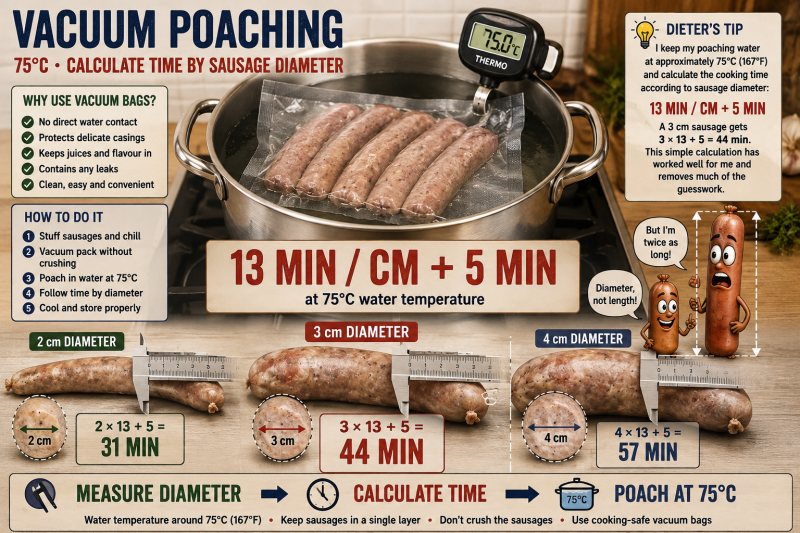
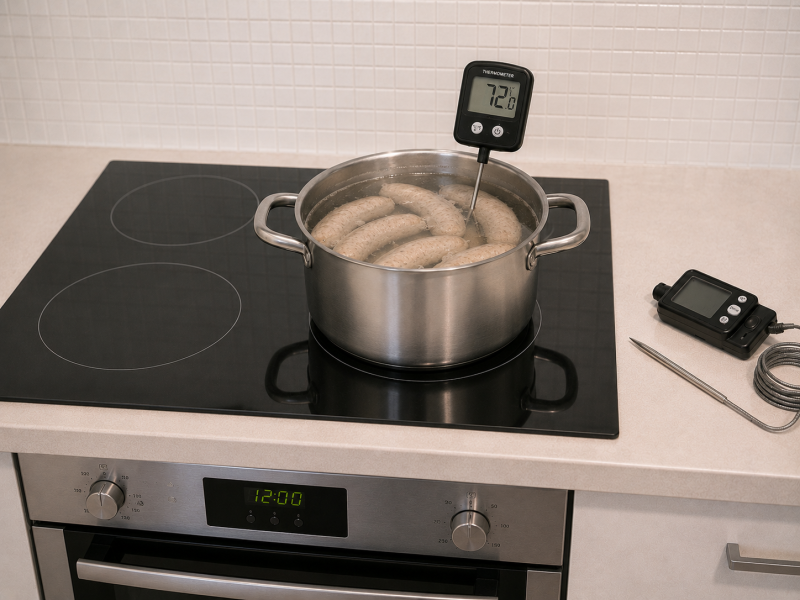
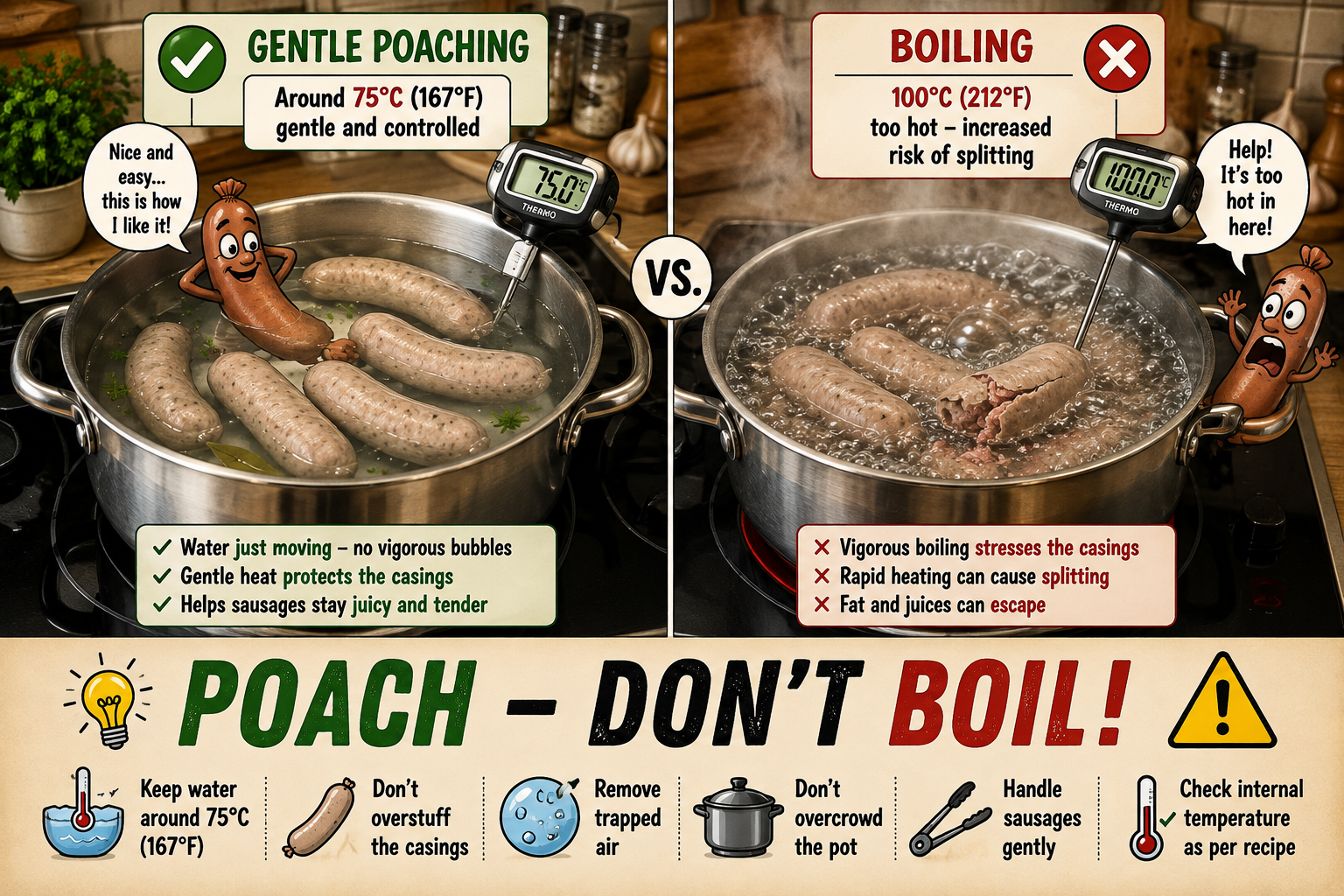
Sausages intended for poaching should be cooked gently in hot water, not boiled. For many of the sausages we prepare here, I aim to keep the poaching water at around 75°C (167°F).
This provides gentle, controlled heating while reducing unnecessary stress on the casing and helping the sausage retain its moisture and fat.
Once the sausages are added, the water temperature will naturally drop. Allow it to recover gradually and adjust the heat as necessary to keep it close to the target temperature.
A violently boiling pot is much harder on a sausage casing. Rapid heating increases pressure inside the sausage, can encourage fat separation and makes splitting considerably more likely.
If the water is boiling, it's too hot for the poaching method we're using.
Follow the Temperature in the Recipe
Not every sausage should be treated exactly the same way.
The recipe should tell you the appropriate poaching temperature and the required internal temperature for that particular sausage.
Use those temperatures rather than assuming that every poached sausage needs the same treatment.
A digital thermometer makes this much easier than trying to judge the water by appearance alone.
Don't Overstuff the Casings
A casing already stretched to its limit before cooking has very little room to accommodate changes as the sausage heats.
As the filling warms, its components change and expand. If the casing is already extremely tight, the pressure can eventually become greater than it can withstand.
The result is a split sausage.
Stuff firmly and evenly, but leave enough flexibility for linking and cooking.
A sausage shouldn't feel like an overinflated balloon.
Remove Large Air Pockets
Trapped air can also create weak areas and uneven pressure beneath the casing.
Inspect your sausages before poaching and release obvious air pockets with a clean, sanitised sausage pricker or very fine needle.
Prick directly over the trapped air and gently massage the filling towards the puncture.
There's no need to perforate the entire sausage.
Don't Shock Ice-Cold Sausages with Excessive Heat
Temperature changes should be controlled rather than violent.
Sausages coming directly from very cold refrigeration don't need to be dropped into boiling water.
Prepare the poaching water at the temperature specified by your recipe and introduce the sausages gently.
The water temperature will usually fall somewhat when the cold sausages are added. Allow it to recover gradually rather than turning the hob to maximum heat and accidentally bringing the pot to a boil.
Don't Overcrowd the Pot
The sausages need enough room for hot water to circulate around them.
If a large quantity is tightly packed into a small pot, the water temperature becomes harder to control and the sausages may heat unevenly.
Use a sufficiently large pot and, if necessary, poach a large batch in more than one load.
Handle the Sausages Gently
Natural casings are remarkably strong, but they aren't indestructible.
Don't drop sausages into the pot, stab them with a fork or repeatedly stir them around.
Lower them gently into the water and move them only when necessary.
If you need to reposition them, use a suitable spoon or tongs carefully enough that you don't pinch or tear the casing.
Watch the Water, Not Just the Clock
A recipe may give an approximate poaching time, but time alone doesn't tell you what is happening inside the pot.
Monitor the water temperature throughout cooking.
Adding cold sausages lowers it. A powerful hob may then cause it to climb surprisingly quickly.
Adjust the heat as necessary to keep the water within the appropriate range.
A lid can help retain heat, but it can also allow the temperature to rise faster than expected, so continue monitoring the thermometer.
Check Internal Temperature
The purpose of poaching is to cook the sausage correctly, not merely to leave it in hot water for a particular number of minutes.
Use a digital probe thermometer to check the internal temperature of a representative sausage, following the safe finishing temperature specified for the particular recipe and meat mixture.
Insert the probe carefully so you don't unnecessarily damage several sausages just to take repeated readings.
What If a Sausage Starts to Split?
If you notice casings beginning to split, check the water temperature immediately.
If it has climbed too high, reduce or remove the heat.
A single split sausage doesn't necessarily mean the entire batch is ruined. That particular casing may have been overfilled, damaged during linking or weakened at one point.
But several sausages splitting at roughly the same time strongly suggests that something about the process needs attention.
Common Reasons Casings Split During Poaching
- water temperature is too high;
- the water is boiling rather than gently poaching;
- casings were overstuffed;
- air pockets weren't removed;
- the casing was damaged during stuffing or linking;
- sausages are being handled too roughly;
- or the sausages have been cooked beyond the required internal temperature.
What About the Cold-Water Bath Afterwards?
Many poached sausages are cooled after cooking to stop the cooking process and bring their temperature down quickly.
Follow the cooling method specified by the recipe. Depending on the sausage, this may involve cool or cold water followed by further refrigeration.
Cooling doesn't repair a casing that has already split during poaching, so the important work happens before and during cooking.
Gentle Heat Produces Better Sausages
Poaching sausages isn't difficult once you stop treating the pot like you're cooking pasta.
Control the temperature, don't overstuff the casings, remove obvious air pockets and handle the sausages gently.
Most importantly, keep an eye on both the water temperature and the sausage's internal temperature.
You're not trying to boil the sausage into submission. You're gently bringing it to its finished temperature.
Do that, and you'll have a much better chance of taking the same intact, juicy sausages out of the pot that you carefully put into it.
Reference: Why Did My Sausage Split?
| Problem | Possible Cause | What to Try Next Time |
|---|---|---|
| Several sausages split during cooking | Poaching water may be too hot. | Monitor the water with a thermometer and prevent it from boiling. |
| Casings split soon after entering the pot | Overstuffing, damaged casing or excessively harsh heating. | Stuff slightly less firmly, inspect the casing and use controlled poaching temperatures. |
| One sausage splits while the others remain intact | Local casing damage, trapped air or an overfilled section. | Inspect the sausages before poaching and release obvious air pockets. |
| Links split near the twists | Links may have been stuffed too tightly before twisting. | Leave enough flexibility in the casing for linking. |
| Sausage remains intact but loses lots of fat | Excessive temperature or an unstable mixture may have caused fat separation. | Check both the poaching temperature and how the sausage mixture was prepared. |
Dieter's Tip
For most of my poached sausages, I aim to keep the water at around 75°C (167°F). When the cold sausages go into the pot, the temperature will drop. Don't compensate by turning the hob up to maximum. Let the water recover gradually and keep watching the thermometer. Gentle, controlled heat is much kinder to both the casing and the sausage inside.