Hang a sausage in a cool room, wait until it loses enough weight and you've made salami.
Unfortunately, it isn't that simple.
Drying sausages is one of the most fascinating parts of traditional sausage making, but it's also an area where home sausage makers need to understand the difference between drying a sausage and making a safe, shelf-stable dry-cured sausage.
Removing moisture changes texture, concentrates flavour and eventually reduces the amount of water available to microorganisms. But moisture loss alone doesn't automatically make a raw sausage safe.
For that reason, this article isn't going to give you a universal temperature, humidity and number of days and tell you to hang raw sausages until they're ready.
There is no single drying schedule that's safe for every sausage.
What Happens When a Sausage Dries?
Fresh meat contains a considerable amount of water. During drying, moisture gradually moves from the centre of the sausage towards the surface and then into the surrounding air.
As water is removed, several things happen:
- The sausage becomes firmer.
- Flavours become more concentrated.
- The sausage loses weight.
- The relationship between salt and remaining moisture changes.
- The amount of water available to microorganisms gradually decreases.
The last point is particularly important.
Moisture Content and Water Activity Aren't the Same Thing
When discussing safely dried foods, you'll often encounter the term water activity, usually written as aw.
This isn't simply a measurement of how much water the sausage contains.
Water activity describes how much water is available for microorganisms and chemical reactions. Salt and other dissolved ingredients bind some of the water, which changes its availability.
That's why two sausages containing a similar percentage of moisture don't necessarily have the same microbiological stability.
Weight loss is useful for monitoring a drying process, but weight loss alone doesn't prove that a sausage is safe or shelf-stable.
Drying Isn't a Kill Step
This is probably the most important point in the entire article.
Putting raw meat into a cool drying environment doesn't reliably destroy pathogens that may already be present.
Drying gradually makes conditions less favourable for microbial growth, but until sufficient hurdles have been established, the sausage can still provide conditions in which undesirable microorganisms survive or grow.
Safe dry sausage production therefore relies on a complete process rather than drying alone.
Dry-Cured Sausages Use Several Safety Hurdles
Traditional dry sausages may look wonderfully simple — meat, fat, seasoning and time — but the underlying process is much more sophisticated.
Depending on the particular sausage, safety may involve a controlled combination of:
- A defined amount of salt
- An appropriate curing product
- A validated fermentation process
- Acidification to a specified pH
- Controlled temperature
- Controlled humidity
- Controlled airflow
- Progressive moisture loss
- A verified final water activity
- Additional pathogen-control steps where required by the process
Changing one part of that system can affect the others.
That's why a recipe for a dry-cured sausage shouldn't be treated like a fresh sausage recipe where we can simply change the seasoning according to taste.
Why Temperature Matters
Temperature influences both microbial activity and the rate at which moisture moves through the sausage.
Too warm and potentially harmful microorganisms may multiply more rapidly.
Too cold and the intended fermentation or drying process may not behave as expected.
The correct temperature therefore depends on the particular recipe and the stage of production.
A cellar that "feels cool" isn't a controlled drying environment.
Why Humidity Matters
It might seem logical that the driest possible air would dry sausages most effectively.
That's actually something we want to avoid.
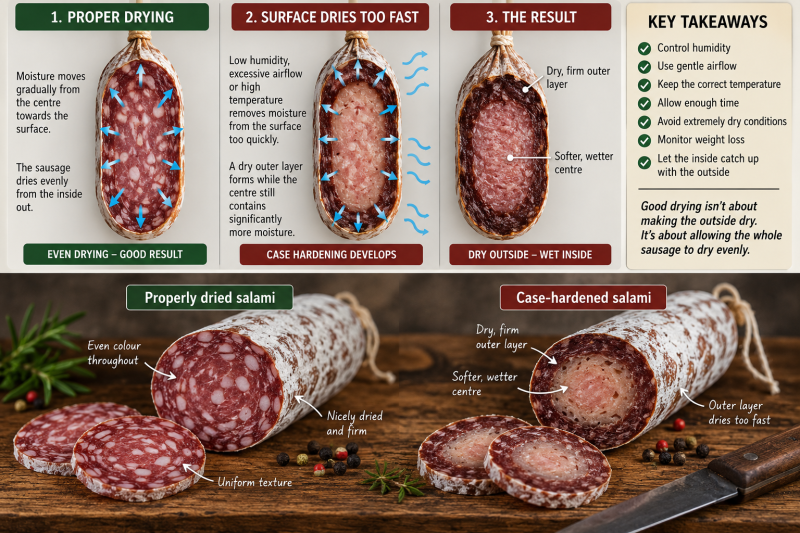
If the outside of a sausage loses moisture much faster than moisture can travel from its centre, the surface can become excessively dry and form a firm outer layer.
This is commonly called case hardening.
The outside may look beautifully dried while the centre remains considerably softer and wetter.
Good sausage drying therefore aims for controlled, progressive moisture loss from the inside towards the outside.
Airflow Helps — Too Much Airflow Doesn't
Air needs to move around the sausages so moisture leaving the casing can be carried away.
But putting a powerful fan directly in front of hanging sausages isn't the answer.
Excessive airflow can dry the surface too quickly and contribute to case hardening.
What we want is gentle, controlled circulation rather than a strong draught.
Why the Kitchen Isn't a Drying Chamber
Hanging sausages from a kitchen rail may look wonderfully traditional, but an ordinary kitchen is usually a poor place for controlled long-term meat drying.
Temperature changes when we cook. Humidity changes. Sunlight may reach the sausages. Airflow varies. Heating or air conditioning can dramatically alter the environment.
The same applies to garages, sheds and balconies.
Outdoor drying of meat introduces even more uncontrolled variables, including weather, insects and large changes in temperature and humidity.
For long-term raw sausage drying, use equipment that allows the required conditions to be monitored and controlled.
A Home Drying Chamber
For enthusiasts who want to progress into fermented and dry-cured sausages, a small dedicated drying chamber can provide much better control than a room in the house.
Depending on the design, a chamber may allow monitoring or regulation of:
- Temperature
- Relative humidity
- Air circulation
But owning a drying chamber doesn't automatically make a recipe safe.
The chamber only provides the environment. You still need a properly developed and validated recipe and process.
Measure — Don't Guess
Traditional sausage makers developed enormous experience by observing their products and environment.
As home sausage makers today, we have inexpensive instruments that remove much of the guesswork.
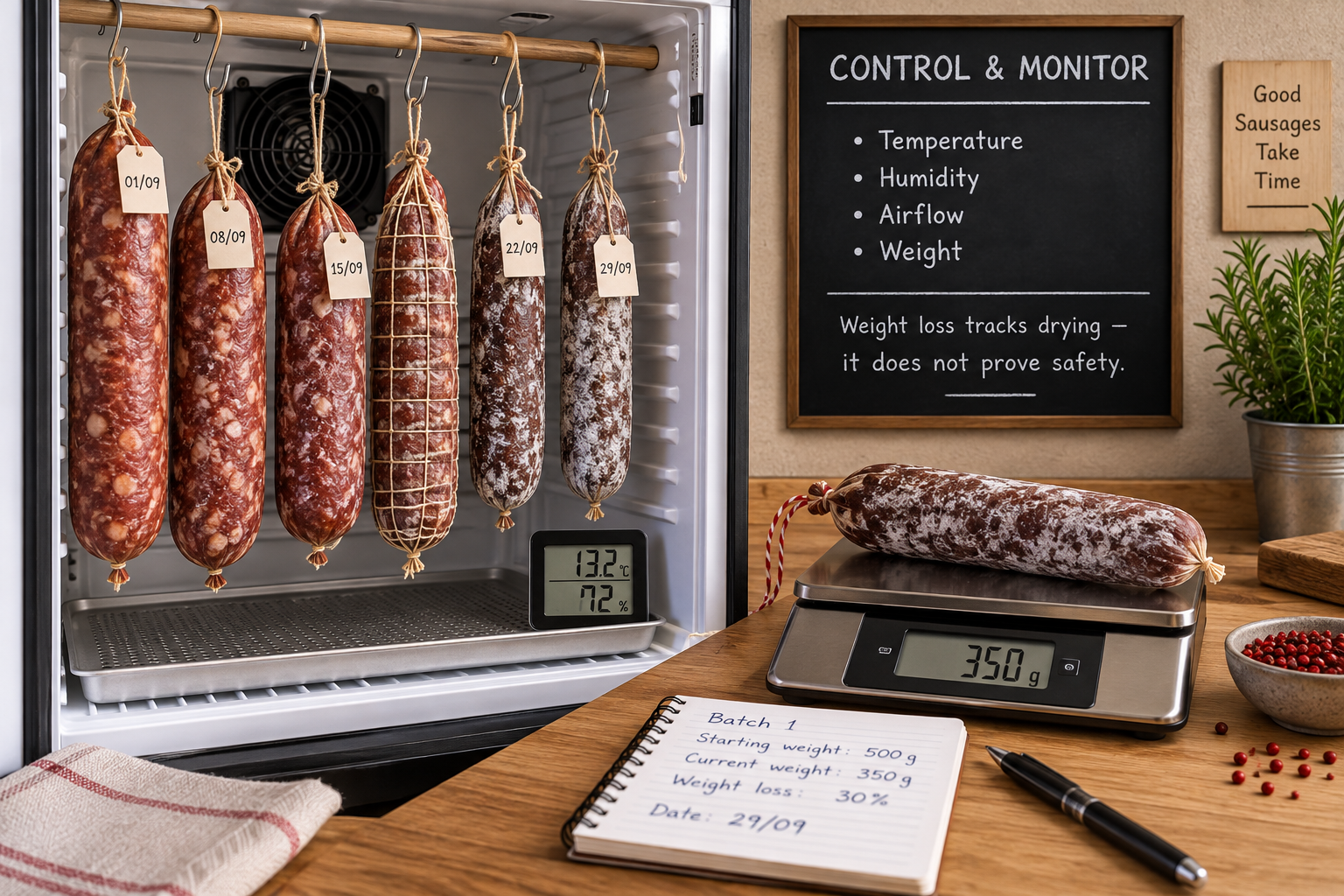
A drying chamber should at least allow you to monitor its actual temperature and relative humidity rather than relying entirely on the controller's displayed setting.
When working with fermented sausages, pH measurement may also form part of the specified process.
For determining whether a product has reached a particular microbiological stability target, water activity requires appropriate measurement. Appearance, firmness and weight loss aren't substitutes for an aw measurement when a process specifies one.
Weight Loss Is Still Extremely Useful
Although weight loss doesn't prove safety, it's an excellent way to follow how a sausage is drying.
Weigh each sausage before drying and record its starting weight.
You can then calculate weight loss:
Weight loss (%) = (Starting weight − Current weight) ÷ Starting weight × 100
For example, a sausage beginning at 500 g and later weighing 350 g has lost:
(500 − 350) ÷ 500 × 100 = 30%
This tells us exactly how much weight has disappeared.
It does not, by itself, tell us that the sausage is safe to eat or safe to store without refrigeration.
Don't Invent Your Own Dry-Curing Recipe
Experimenting is one of the pleasures of sausage making. I regularly adjust spices, herbs and flavour combinations in fresh sausages.
Raw fermented and dry-cured sausage is different.
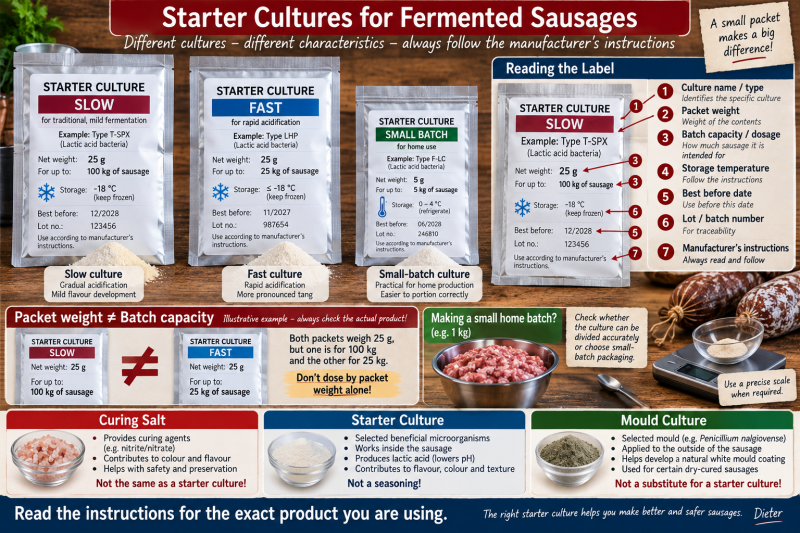
The amounts of meat, fat, salt, cure, sugars and starter culture, together with fermentation and drying conditions, can be part of the safety process.
For your first dry sausages, use a recipe from a reliable source that specifies the complete process and follow it accurately.
Once you understand what's happening, there may be room for carefully validated changes — but safety-critical ingredients and processing conditions shouldn't be changed casually.
Don't Substitute Curing Salts
We've already covered this in detail in our article Understanding Curing Salts, but it's especially important here.
Curing products sold in different countries can contain very different concentrations of nitrite and nitrate.
Never assume that two products called "curing salt" can be substituted gram for gram.
Use the exact type and concentration required by the recipe and follow the manufacturer's instructions.
Fermentation Is More Than Leaving Sausages Somewhere Warm
Many dry sausages are fermented before or during drying.
Controlled fermentation encourages the intended bacteria to produce acid, reducing pH and contributing to flavour, texture and safety.
This stage requires the correct culture, formulation, temperature, time and measurable endpoint specified by the process.
Simply hanging raw sausage somewhere warm for a day isn't a substitute for controlled fermentation.
Mould Needs Its Own Discussion
Anyone exploring traditional salami will eventually encounter sausages covered in beautiful white mould.
Some moulds are deliberately encouraged in particular dry-cured sausage processes and can contribute to flavour and surface protection.
Other mould growth may indicate a problem.
Because identifying and managing sausage mould safely deserves more than a paragraph, we'll cover mould on dry-cured sausages separately rather than suggesting that any white coating is automatically harmless.
When Should You Throw a Sausage Away?
If a sausage develops unexpected spoilage, an abnormal odour, unusual sliminess, uncontrolled mould growth or conditions have moved substantially outside the requirements of the recipe, don't try to rescue it by simply drying it longer or cooking it later.
And don't taste a questionable sausage to decide whether it's safe.
When the safety of a preserved meat product is uncertain, discarding it is the sensible choice.
Keep Refrigerated Unless the Process Says Otherwise
A sausage becoming firmer and drier doesn't automatically mean it has become shelf-stable.
Unless you're following a validated process that establishes the required stability of the finished product, treat the sausage according to the refrigeration and storage instructions of the recipe.
"Looks like salami" isn't a storage instruction.
A Safe Way to Start
If you're new to sausage making, there is no reason to begin with raw fermented salami.
Start with fresh sausages. Learn temperature control, grinding, mixing, stuffing and linking.
Then move into properly cooked and smoked sausages, where you'll learn curing, drying the casing before smoking, temperature control and smoke management.
When you're comfortable with those processes, fermented and dry-cured sausages become a natural next step — but use a proven recipe and a controlled environment.
Drying Is About Control, Not Just Time
The romantic image of sausages hanging from wooden beams for months isn't wrong — generations of sausage makers produced wonderful products that way.
But those methods belonged to established recipes, particular climates, experienced producers and environments that people understood intimately.
For the modern home sausage maker, we can achieve the same goal much more reliably by understanding what we're controlling.
Temperature. Humidity. Airflow. Fermentation. pH. Water activity. Cure. Time.
Drying removes moisture.
Safe dry-curing is the complete process.
Dieter's Tip: Don't use weight loss as your only definition of "finished." I weigh sausages because it tells me how drying is progressing, but a 30%, 35% or 40% weight loss isn't by itself proof that a raw fermented sausage is safe. Follow the endpoint specified by the recipe and keep records of what happened during the process.