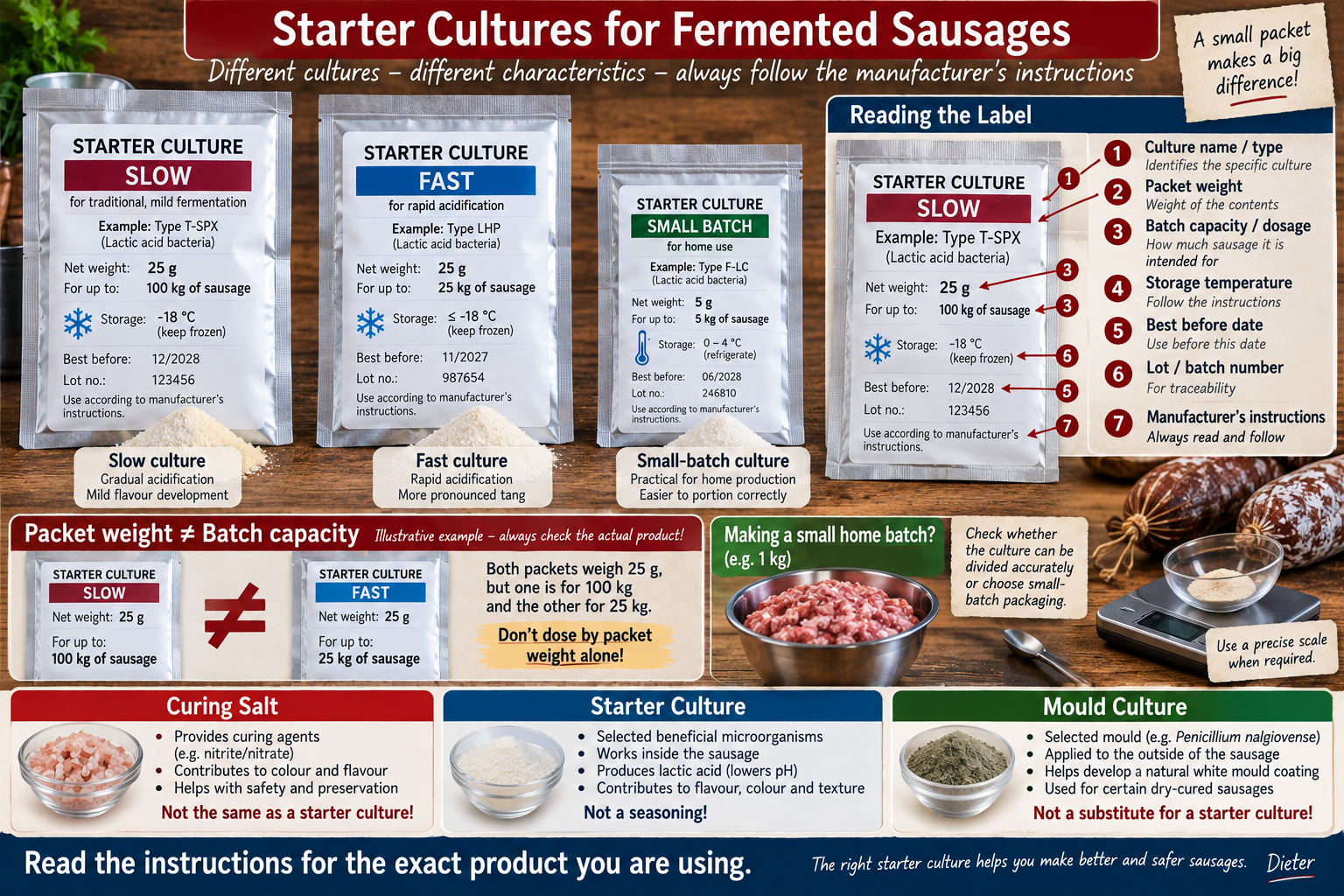
If you're making your first fermented sausage, one of the ingredients on the recipe may look rather unfamiliar:
Starter culture.
Unlike salt, pepper or garlic, you can't judge how much you need simply by looking at it. A tiny packet may be enough for a surprisingly large quantity of sausage, and two cultures that look virtually identical can behave very differently.
Then there are names such as T-SPX, F-RM-52, F-LC and LHP.
What do they mean? Which one should you buy? And can you substitute one for another?
Let's take the mystery out of starter cultures.
What Is a Sausage Starter Culture?
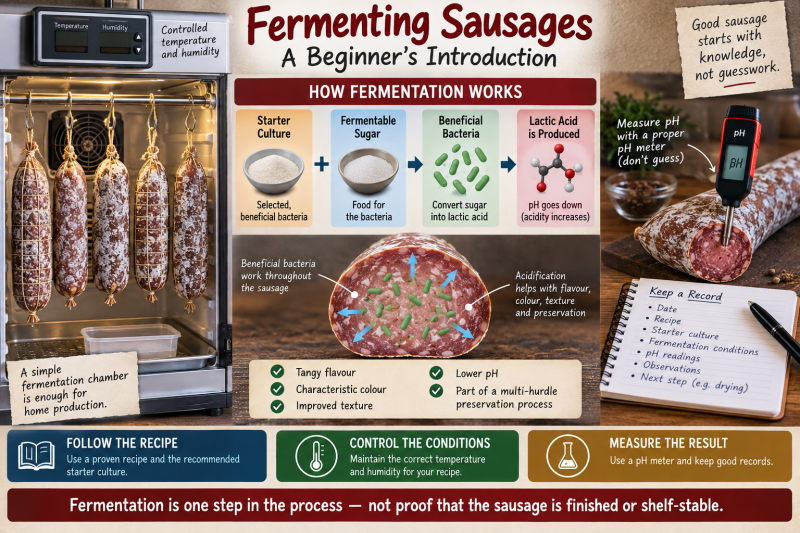
A starter culture contains selected microorganisms that are deliberately introduced into a sausage mixture to produce a controlled fermentation.
Many commercial meat starter cultures are supplied as concentrated freeze-dried preparations.
Once introduced into the sausage under the correct conditions, particular bacteria use fermentable carbohydrates in the recipe and produce acids, especially lactic acid.
This causes the pH of the sausage to fall.
Depending on the organisms included, starter cultures can also contribute to:
- Acidification
- Characteristic fermented flavour
- Aroma development
- Cured colour development and stability
- Texture development
- Competition against undesirable microorganisms
Different cultures have been selected to perform these jobs differently.
That's why there isn't one universal "salami starter."
Starter Culture Isn't a Seasoning
This distinction is important.
If you leave a gram of pepper out of a fresh sausage recipe, you've primarily changed its flavour.
If you change the starter culture in a fermented sausage, you may change the behaviour of the fermentation itself.
The culture works together with the fermentable sugar, temperature, time, curing ingredients and other parts of the process.
Treat starter culture as a process ingredient, not simply another flavouring.
Why Use a Commercial Starter Culture?
Traditional sausage makers didn't always have packets of freeze-dried bacteria.
Historically, fermentation could rely on microorganisms naturally present in the ingredients, equipment and production environment.
Successful producers developed processes that repeatedly encouraged the microorganisms they wanted.
But that's not a particularly sensible starting point for someone making their first salami in a home kitchen.
Commercial starter cultures allow us to deliberately introduce selected organisms in sufficient numbers and make fermentation considerably more predictable.
For home production, predictability is a major advantage.
Slow, Medium and Fast Cultures
One useful way for beginners to understand starter cultures is by the speed and character of their acidification.
You'll commonly encounter descriptions such as slow, medium and fast.
These aren't rigid universal categories, but they help explain why different cultures produce different styles of sausage.
Slow Cultures
Slow cultures generally produce a more gradual and moderate acidification.
They are commonly associated with traditionally matured Southern European and Mediterranean-style dry sausages where pronounced sourness isn't the objective.
Bactoferm T-SPX is a well-known example.
Its gradual fermentation is associated with mild acidity and the development of a rounded, matured flavour.
Medium or Moderately Fast Cultures
Other cultures produce acidification more rapidly while still supporting flavour and colour development.
These may suit sausage styles where a somewhat quicker fermentation or more noticeable acidity is wanted.
Bactoferm F-RM-52 is one example frequently encountered in fermented sausage recipes.
Fast Cultures
Fast cultures can produce considerably quicker and stronger acidification.
They are often associated with North American-style fermented products where a more noticeable tang may be desirable, including some pepperoni and summer sausage styles.
LHP-type cultures are a familiar example.
But don't make the mistake of thinking:
"Fast must be safer, so I'll use the fastest culture in everything."
The culture needs to match the sausage and the complete process.
Culture Choice Influences Flavour
Fermentation speed isn't merely about how quickly you can finish making the sausage.
The rate and extent of acidification influence the character of the finished product.
A slowly matured Mediterranean salami shouldn't necessarily have the same sharp acidic character as a tangy American summer sausage.
That means culture choice is partly responsible for what makes different fermented sausage traditions taste different.
The objective isn't maximum acidity.
The objective is the fermentation required by that particular sausage.
Some Cultures Provide Additional Protective Functions
Modern starter cultures can contain organisms selected for more than acidification and flavour development.
Some are designed to provide additional competitive or protective effects against particular undesirable microorganisms.
You may therefore see products described as protective or bioprotective cultures.
That can be useful, but it doesn't turn the culture into a complete food-safety system.
The recipe still needs the correct curing ingredients, fermentation conditions and subsequent processing steps.
Bioprotection is another hurdle, not permission to ignore the others.
Why Culture Names Matter
Names such as T-SPX and F-RM-52 aren't simply different brands of the same ingredient.
They identify cultures with different organisms and fermentation characteristics.
If a proven recipe specifies a particular starter culture, don't automatically substitute whatever culture happens to be available.
A substitution may change:
- Fermentation speed
- Required temperature
- Acidification
- Final flavour
- Colour development
- The time required to reach the specified fermentation endpoint
If the specified culture is unavailable, use an alternative only when you have reliable information showing how it should be incorporated into that particular process.
The Packet Size Trap
This is probably the most confusing part of starter cultures for home sausage makers.
You might buy a packet containing:
25 g starter culture.
It is very tempting to assume that you simply calculate the number of grams needed per kilogram of meat.
But the important information isn't only the physical weight of the packet.
You need to know how much sausage the manufacturer intends that packet to inoculate.
A 25 g packet of one culture might be intended for a very large batch, while another product with a similar packet weight can have a different recommended application rate.
So:
PACKET WEIGHT ≠ DOSAGE
Always read the specification for the exact culture you're using.
What About Our 1 kg Home Batches?
This becomes particularly relevant in Dieter's Sausage Kitchen because I generally prefer recipes based around manageable 1 kg batches.
Commercial cultures, however, were often designed with much larger sausage production in mind.
A packet intended for tens or even hundreds of kilograms of meat creates an obvious problem when we're making only 1 kg.
Don't simply look at the packet weight and improvise.
Check the manufacturer's or supplier's instructions for:
- The intended batch capacity
- The recommended application rate
- Whether the product may be portioned
- How it should be dispersed or activated, if required
- How an opened package should be stored
Where a manufacturer provides instructions specifically for small batches, follow those instructions.
If a culture is supplied in a package poorly suited to home quantities, buying a product packaged specifically for smaller batches may be the better solution.
Can I Just Divide a 25 g Packet?
Mathematically, dividing a packet seems straightforward.
But we're dealing with a concentrated biological product rather than ordinary salt.
Different products may contain carrier material and several different microorganisms, and manufacturers can specify particular handling and dosing procedures.
For that reason, I don't recommend inventing a universal rule such as:
"Use X grams of every starter culture per kilogram."
Use the dosing instructions for the exact product in your hand.
Use an Accurate Scale Where Appropriate
If the manufacturer's directions require you to measure a small quantity of culture, an ordinary kitchen scale that reads only to the nearest gram isn't suitable.
A small precision scale may be necessary.
But accuracy of weighing doesn't replace the manufacturer's instructions.
Being able to weigh 0.25 g very accurately doesn't mean 0.25 g is the correct amount for your particular culture.
How Should Starter Culture Be Stored?
Starter cultures contain living microorganisms, so storage matters.
Many freeze-dried meat cultures require refrigerated or frozen storage, and temperature can influence their usable storage life.
However, storage instructions vary between products.
Check:
- Storage temperature
- Expiry or best-before date
- Instructions after opening
- Whether repeated warming and cooling should be avoided
- Transport recommendations
Don't assume that because one culture lives in your freezer, every culture should be treated identically.
Ordering Starter Cultures Online
Starter cultures are commonly ordered by mail, which raises an understandable question:
What happens while they're being transported?
Some manufacturers permit their freeze-dried cultures to tolerate limited periods outside frozen storage during transport.
The permitted conditions depend on the particular product.
Check the supplier's transport information before ordering, especially if the parcel must travel a long distance or will be exposed to very hot weather.
Once the culture arrives, store it according to its instructions.
Starter Culture, Curing Salt and Mould Culture Are Different Things
Beginners can easily encounter all three products while shopping for salami ingredients.
They are not interchangeable.
Starter Culture
Works primarily inside the sausage and drives the controlled fermentation.
Curing Salt
Provides the appropriate curing agents required by the recipe and contributes to cured colour, flavour and microbial control.
We've covered this separately in our article Understanding Curing Salts.
Mould Culture
Selected mould cultures are applied to the outside of appropriate dry-cured sausages to encourage a desired surface mould.
The familiar white coating on many traditional salamis is an example.
A mould culture doesn't replace the starter culture fermenting the meat inside.
CURING SALT ≠ STARTER CULTURE ≠ MOULD CULTURE
Does Every Fermented Sausage Need White Mould?
No.
White mould is characteristic of certain dry-cured sausage styles, but it isn't a compulsory sign that fermentation has worked.
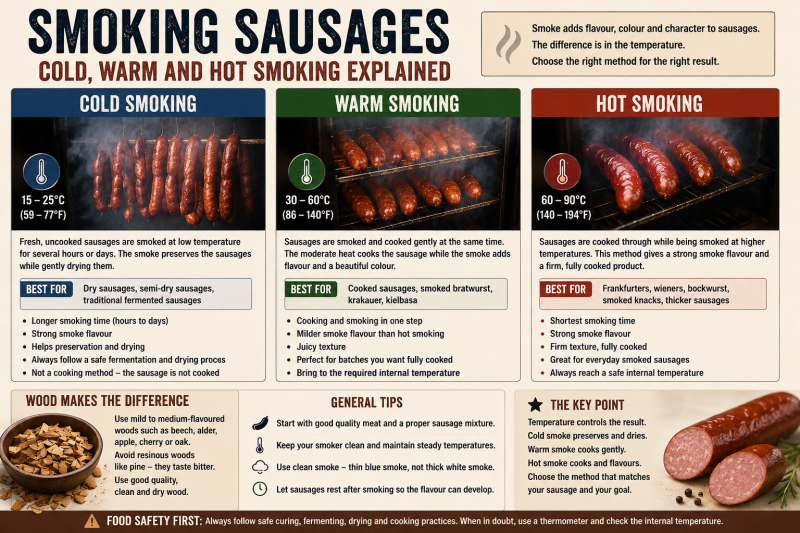
Some fermented sausages are smoked, some are cooked after fermentation, some are dried without a deliberately inoculated mould culture, and others traditionally develop a mould-ripened surface.
Follow the process appropriate to the sausage you're making rather than assuming every salami needs to turn white.
Don't Choose a Culture by Sausage Name Alone
You may find tables online saying:
Salami = Culture A
Pepperoni = Culture B
Chorizo = Culture C
These can be useful as a general indication, but sausage names cover enormous variations in formulation and processing.
Two recipes both called "salami" can use quite different fermentation processes.
Instead, start with the proven recipe and determine which culture that process was designed around.
The recipe determines the culture — not the other way around.
Can Starter Culture Make an Unsafe Recipe Safe?
No.
Starter culture is one component of a complete process.
It doesn't compensate for incorrect curing salt, unsuitable fermentation conditions, poor hygiene, uncontrolled drying or an unvalidated formulation.
Likewise, successfully lowering the pH doesn't automatically mean a dry sausage is finished or shelf-stable.
The sausage still needs to complete whatever subsequent processing the recipe requires.
A Practical Beginner's Approach
If you're preparing to make your first fermented sausage, I suggest keeping things simple.
- Choose a proven beginner-friendly recipe.
- Buy the exact starter culture specified by that recipe where possible.
- Read the manufacturer's current instructions before beginning.
- Check its storage requirements.
- Check its intended batch capacity and dosage.
- Use the specified fermentable carbohydrate.
- Control the required fermentation conditions.
- Measure the fermentation endpoint required by the process.
- Continue with the specified drying, smoking or cooking process.
Once you've successfully made a few fermented sausages, the differences between cultures will begin to make much more sense.
Where Can Home Sausage Makers Buy Starter Cultures?
Starter cultures aren't always available from ordinary supermarkets or even local butchers, so online specialist suppliers are often the easiest option.
The following suppliers were checked when this article was prepared. Product ranges, shipping destinations and availability can change, so always check the supplier's current information before ordering.
Supplier information last checked: September 2026.
Europe
Startercultures.eu – Netherlands
A specialist fermentation supplier carrying sausage starter cultures, surface mould cultures, curing ingredients and related equipment. Their current range includes several cultures suitable for different fermentation styles, and they state that they ship throughout Europe.
Krahmers-shop – Germany
A German sausage-making supplier carrying several professional starter cultures in consumer-accessible packages. Their product listings provide useful information including intended batch size, storage and transport requirements. EU delivery is available according to their current shipping information.
Professional European Supplier
Nubassa Gewürzwerk – Germany
Nubassa produces and sells starter and ripening cultures for raw sausage production. However, its online shop currently states that its offers are intended for businesses and commercial customers rather than private consumers. International customers are asked to contact the company regarding export orders.
North America
The Sausage Maker – United States
A specialist home and small-scale sausage-making supplier carrying several Bactoferm cultures and other ingredients and equipment for fermented sausage production.
Whichever supplier you use, don't buy simply on price.
Check that the product is clearly identified, supplied with meaningful usage and storage information and suitable for the recipe you intend to make.
One Packet Can Make a Lot of Sausage
Starter culture can initially look expensive when compared with ordinary spices.
But remember that these products are concentrated and a single packet may be designed to inoculate a considerable quantity of sausage.
For home sausage makers, the greater challenge is often not the cost per kilogram of sausage but finding packaging and handling instructions appropriate to our much smaller batches.
The Simple Rule
If you remember only one thing from this article, make it this:
Don't choose or dose a starter culture by guesswork.
Start with the sausage process you want to follow, use the culture specified for it, read the instructions for the exact product and measure the fermentation result.
Starter cultures actually make fermented sausage making easier for the home producer.
Rather than hoping that the right microorganisms happen to take control, we're deliberately introducing organisms selected to do the job.
The little packet isn't mysterious once you understand what it's there to do.
Dieter's Tip: Buy your starter culture before preparing the meat and read the packet while you still have time to change plans. Check the culture, dosage, storage requirements, fermentation conditions and expiry date first. Discovering after stuffing that your culture requires a different process is rather too late.