Few things give homemade sausages as much character as smoke.
The aroma of wood smoke, the deepening colour of the casing and the flavour it leaves behind can transform a relatively simple sausage into something completely different.
But saying that a sausage is "smoked" doesn't actually tell us very much about how it was made.
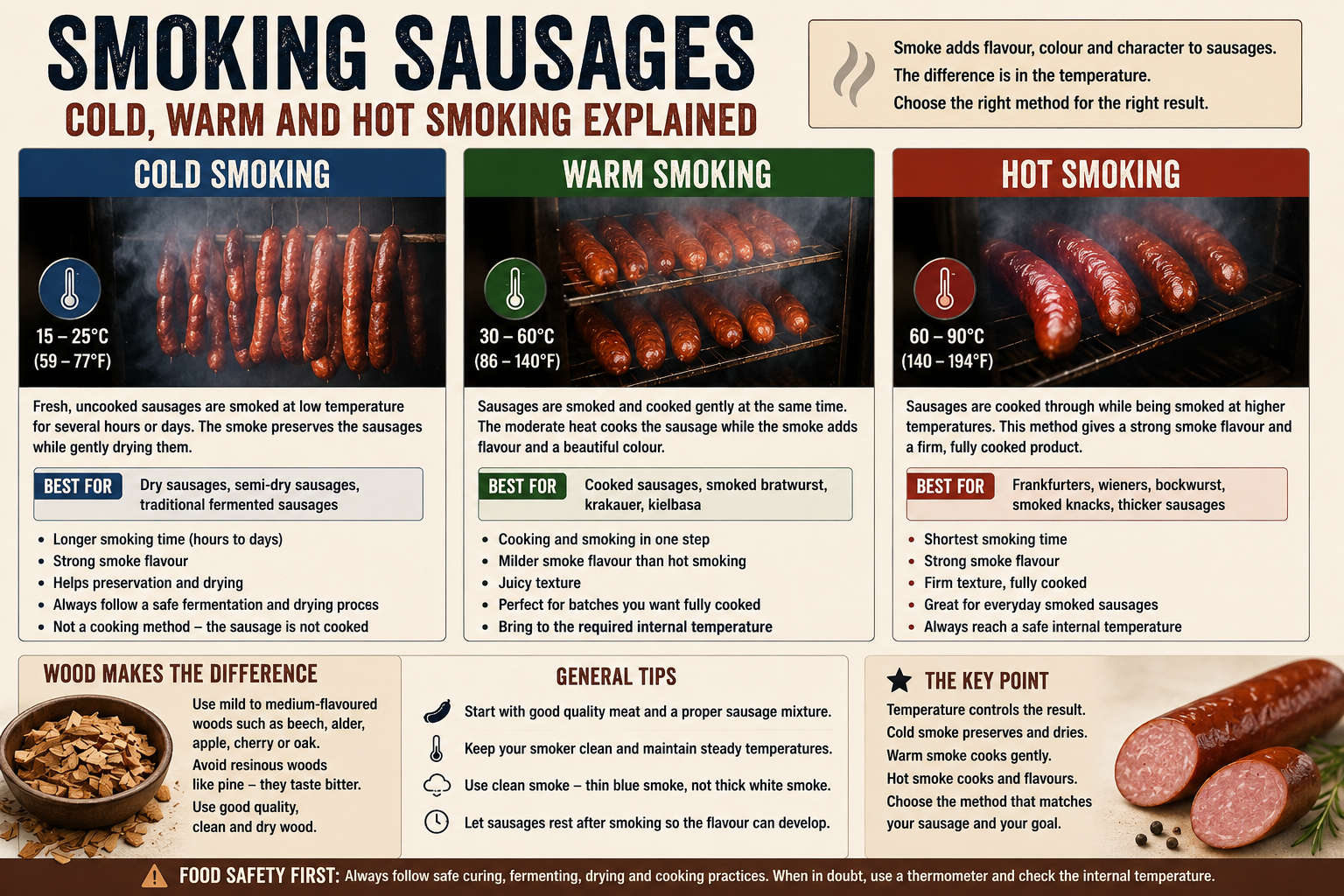
Cold smoking, warm smoking and hot smoking operate at very different temperatures and can have very different purposes. One may primarily add flavour during a longer curing or drying process, while another can smoke and cook the sausage at the same time.
Understanding that difference is important before you put your first batch into the smoker.
Smoke Is More Than Flavour
We usually notice the flavour first, but smoking affects several characteristics of a sausage.
Depending on the process, smoke can contribute:
- the characteristic smoky aroma and flavour;
- a deeper and more attractive surface colour;
- changes to the surface of the casing;
- some antioxidant and antimicrobial effects;
- and, when heat is involved, cooking of the sausage itself.
What smoke does not do is automatically make an otherwise unsafe sausage safe.
This becomes particularly important when we talk about cold smoking.
Cold Smoking
Cold smoking takes place at temperatures low enough that the sausage isn't being cooked by the smoking process.
Depending on the product, equipment and tradition, temperatures can vary, but cold smoking is generally carried out at approximately 15–25°C (59–77°F).
The objective is to expose the sausage to smoke while keeping heat to a minimum.
This allows smoke flavour and colour to develop gradually without cooking the meat.
Cold Smoking Is Not Cooking
This is the most important thing to understand about the method.
A raw sausage doesn't become cooked simply because it has spent several hours surrounded by smoke.
Cold smoking is therefore normally part of a larger process for products specifically formulated for curing, fermentation, drying or subsequent cooking.
Don't take an ordinary fresh raw sausage, cold smoke it for several hours and assume that the smoke has made it safe to eat or store.
If a recipe involves cold smoking, follow the complete curing, fermentation, drying and/or cooking procedure specified for that product.
Why Use Cold Smoke?
The great advantage of cold smoking is control over flavour.
Because we're not simultaneously trying to cook the sausage, smoke can be introduced gradually. Depending on the product, smoking may take place in one session or in repeated sessions separated by resting or drying periods.
This can create considerably more complex smoke character than simply exposing a sausage to very hot smoke for a short time.
Cold smoking is particularly associated with traditional cured and dried meat products.
Warm Smoking
Warm smoking occupies the broad territory between cold smoking and full hot smoking.
You'll encounter different definitions depending on country, tradition and equipment, so I prefer to think about warm smoking in practical rather than rigid terms.
The smoker is warm enough to begin heating the sausage significantly, but the process remains relatively gentle and controlled.
A broad working range might be approximately 30–60°C (86–140°F), although the recipe you're following should always determine the actual temperature.
Warm smoking is useful when we want smoke development together with gradual heating rather than immediately subjecting the sausage to higher temperatures.
Warm Smoking Can Be Part of a Staged Process
One advantage of a smoker with good temperature control is that we don't necessarily have to choose one temperature and leave it there from beginning to end.
A sausage can be dried initially, exposed to smoke at a lower temperature and then gradually taken through warmer stages before being finished at a higher temperature or by another cooking method.
This staged approach is common with many cooked and smoked sausages.
Gradually increasing the temperature can also be kinder to the sausage than immediately exposing a cold product to high heat.
Hot Smoking
With hot smoking, smoke and cooking happen together.
The smoker operates at temperatures high enough to progressively cook the sausage while the smoke provides flavour and colour.
Depending on the sausage and method, smoker temperatures may commonly be somewhere around 60–90°C (140–194°F).
Again, that is a broad description rather than a universal recipe.
The important difference is that with hot smoking we're intentionally using heat to bring the sausage towards its required finished internal temperature.
Don't Confuse Smoker Temperature with Internal Temperature
This distinction is extremely important.
If the smoker is running at 75°C, that doesn't mean the centre of the sausage is also at 75°C.
The smoker temperature tells us about the environment surrounding the sausage.
The internal temperature tells us what is happening inside it.
When hot smoking sausages, use a suitable thermometer and follow the required internal finishing temperature for the particular sausage and meat mixture you're preparing.
Why Not Simply Turn the Smoker Up?
If higher temperature cooks the sausage faster, it may seem logical to turn the smoker up and finish the job quickly.
Unfortunately, sausages don't always appreciate that approach.
Excessive heat can cause the fat inside the sausage to soften and separate before the meat structure has properly set.
You may end up with:
- fat collecting beneath the casing;
- a dry or crumbly interior;
- wrinkled casings;
- split sausages;
- or fat and juices dripping into the smoker.
Gentle, controlled heating usually gives a much better result.
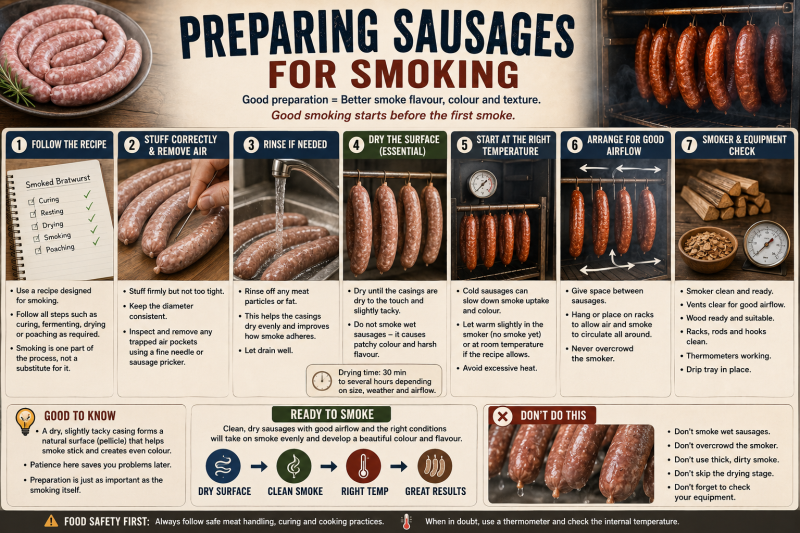
Dry the Sausage Surface Before Smoking
Before smoke is introduced, the surface of the sausage should normally be allowed to dry.
A slightly tacky, dry surface accepts smoke much more evenly than a wet casing.
If the sausages go into the smoker dripping wet, smoke colour can become uneven and the finished appearance may be blotchy.
After stuffing or rinsing, allow the sausages to dry according to the recipe before beginning the smoking stage.
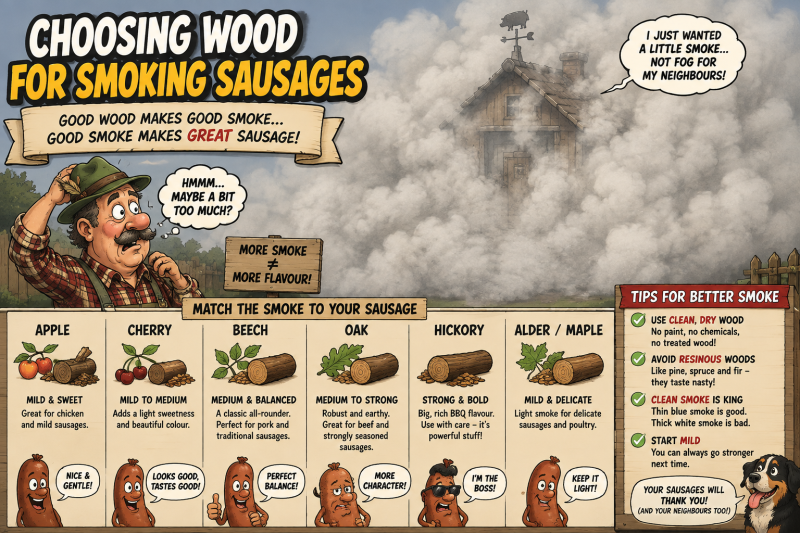
Good Smoke Doesn't Mean Lots of Smoke
One of the mistakes I made when first experimenting with smoking was assuming that more visible smoke must mean more flavour.
It doesn't.
Thick, heavy smoke can leave sausages harsh, bitter and unpleasant.
What we're looking for is a clean, controlled fire producing a relatively light stream of good-quality smoke.
You want to smoke the sausage—not hide it in a cloud.
Choosing Wood for Sausages
Different woods produce noticeably different flavours.
Traditional choices vary considerably by region, but hardwoods and fruitwoods are generally the starting point for sausage smoking.
Useful choices include:
- Beech – a classic choice for many Central European sausages with a balanced smoke character;
- Oak – stronger and more robust;
- Apple – mild, slightly sweet and particularly useful when you don't want smoke to dominate;
- Cherry – mild to medium smoke with attractive colour development;
- Hickory – stronger and more assertive, particularly familiar in American-style smoking.
Avoid resinous softwoods such as pine. They can produce unpleasant flavours and aren't suitable smoking woods for sausages.
Wood Choice Should Suit the Sausage
There isn't one "best" smoking wood.
A strongly seasoned beef or pork sausage can cope with a more assertive smoke than a delicate chicken sausage.
Likewise, if the sausage will spend many hours being smoked, a milder wood may produce a more balanced result than an aggressive one.
Think of smoke as another seasoning. It should complement the sausage rather than completely overpower it.
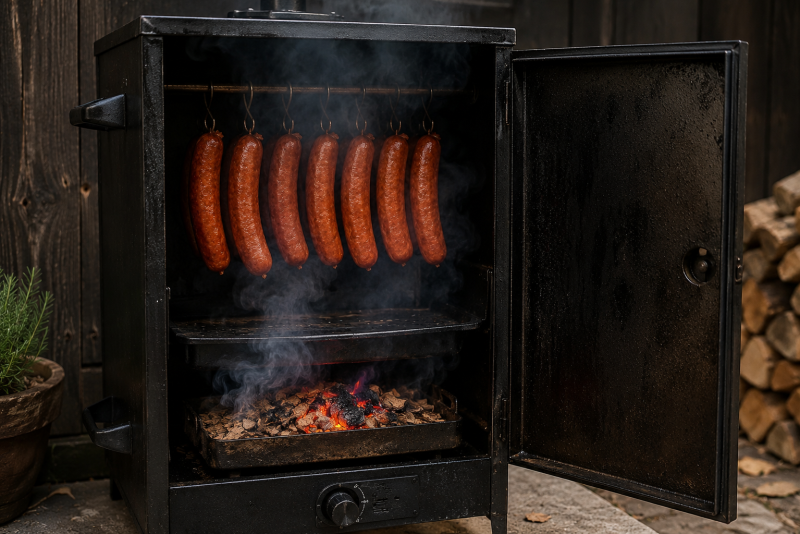
Airflow Matters
A smoker needs airflow.
Restricting the vents in an attempt to trap every bit of smoke inside can produce stale, heavy smoke and poor combustion.
Fresh smoke needs to enter, move around the sausages and leave again.
Good temperature control and good airflow are just as important as the amount of wood you're using.
Give the Sausages Some Space
Whether sausages are hanging from rods or sitting on racks, don't pack them tightly together.
Smoke and warm air need to circulate around the surface.
If sausages are touching throughout smoking, those contact points may remain noticeably paler than the rest of the casing.
Leave a little space between them wherever possible.
What Happens After Smoking?
That depends entirely on the type of sausage.
A hot-smoked sausage may already have reached its required internal temperature and be ready for cooling.
A warm-smoked sausage may require another cooking stage.
A cold-smoked cured sausage may continue into drying or maturation.
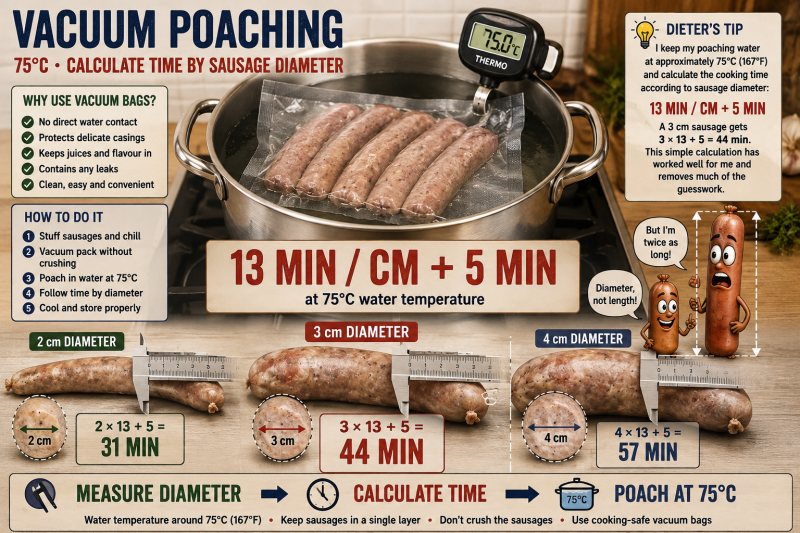
Some sausages may be smoked primarily for flavour and then poached to finish cooking.
This is why smoking temperature should never be considered in isolation.
Smoking is one stage in the recipe, and what comes before and after it matters just as much.
Cold, Warm or Hot?
| Method | Typical Smoker Range | Main Purpose | Does It Cook the Sausage? |
|---|---|---|---|
| Cold Smoking | Approx. 15–25°C (59–77°F) |
Smoke flavour, colour and part of a curing/drying process | No |
| Warm Smoking | Approx. 30–60°C (86–140°F) |
Smoke development with gentle progressive heating | Partially or progressively, depending on process |
| Hot Smoking | Approx. 60–90°C (140–194°F) |
Smoking and cooking | Yes, when continued to the required internal temperature |
Temperature ranges are general guides rather than universal specifications. Always follow the temperatures, curing requirements and finishing method specified for the particular sausage you're making.
The Temperature Determines the Technique
The difference between cold, warm and hot smoking isn't simply how smoky you want your sausage to taste.
Temperature changes what is happening to the meat.
Cold smoking adds smoke without cooking. Warm smoking combines smoke with gentle heating. Hot smoking uses smoke while actively cooking the sausage.
Once you understand that distinction, choosing a smoking method becomes much easier.
Start with a recipe designed for the method you're using, control the temperature carefully, use clean smoke and give the process the time it needs.
Your smoker will then become much more than a box for adding smoke—it becomes another tool for controlling the flavour, colour and texture of your sausages.
Dieter's Tip
Don't judge your smoke by how impressive the cloud looks. I would rather see a light, steady stream of clean smoke than thick white smoke pouring from the smoker. Smoke is a seasoning just like salt or pepper—you want to taste it in the finished sausage, but you don't want it to overpower everything else.