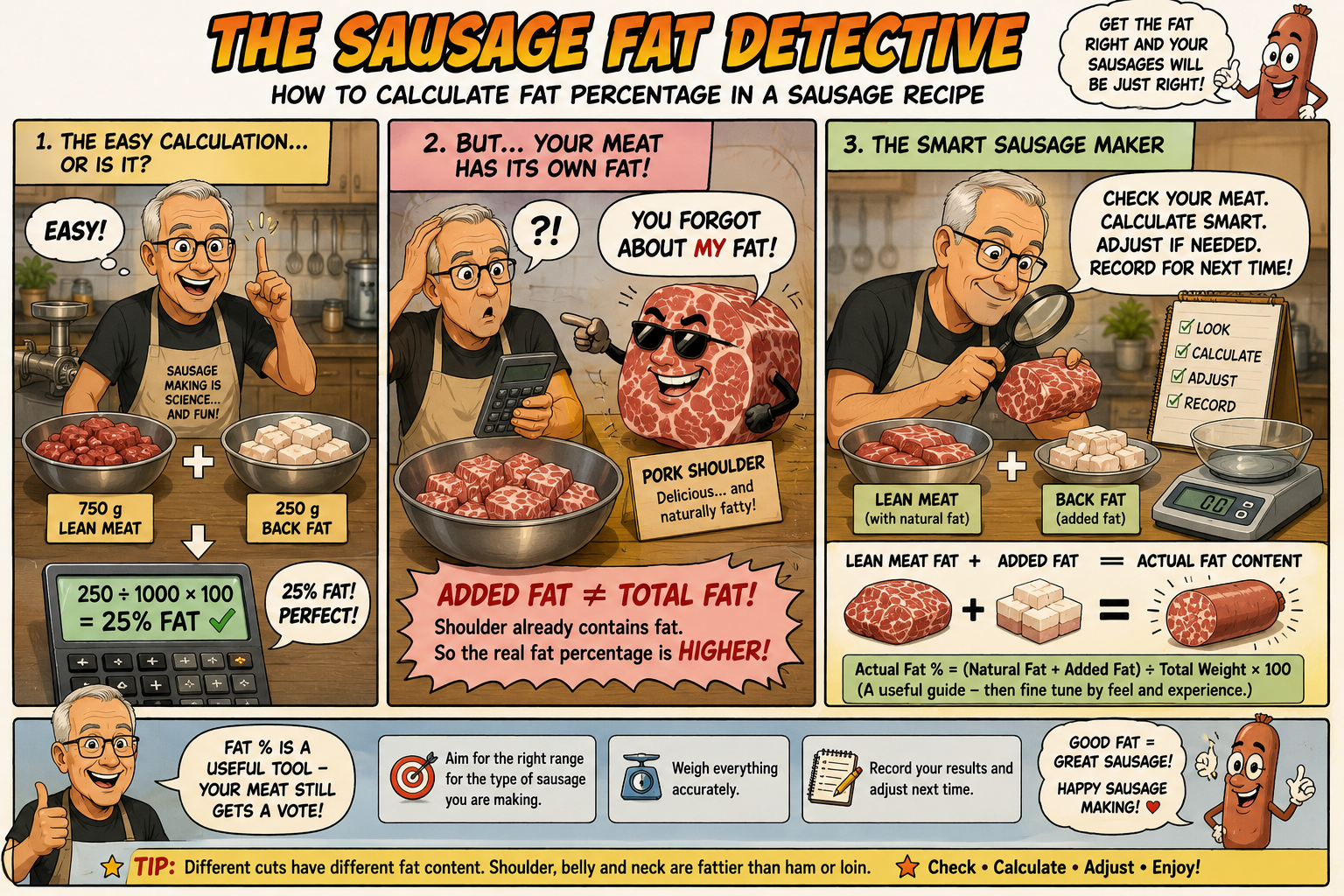
Fat plays an essential role in sausage making. It contributes flavour, juiciness and texture, and getting the balance right can make the difference between a succulent sausage and one that is dry and crumbly.
You'll often see sausage recipes described as containing 20%, 25% or 30% fat. At first glance, calculating this seems simple—and sometimes it is. But there's an important detail that is easily overlooked:
The meat you're using may already contain a considerable amount of fat.
Understanding this distinction will help you develop your own recipes and make sensible adjustments when substituting one cut of meat for another.
The Simple Calculation
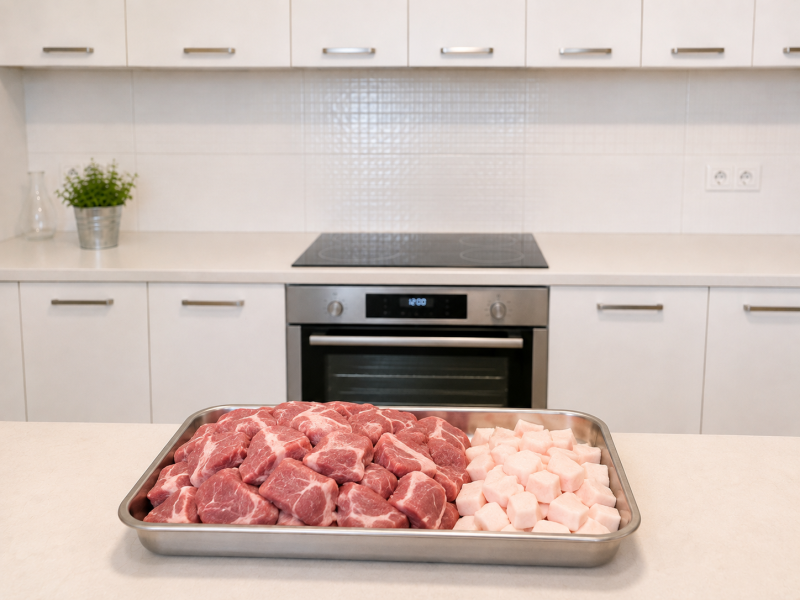
If you're working with completely lean meat and pure fat, calculating the percentage is straightforward.
Divide the weight of the fat by the total weight of the meat and fat, then multiply by 100.
Fat percentage = fat weight ÷ total meat and fat weight × 100
For example, suppose we have:
- 750 g lean meat
- 250 g pork back fat
The total meat and fat weight is 1,000 g.
250 ÷ 1,000 × 100 = 25% fat
That gives us a mixture containing approximately 75% lean meat and 25% fat.
But Meat Isn't Usually Completely Lean
This is where the calculation becomes more interesting.
Pork shoulder, beef chuck, chicken thighs and many other cuts commonly used for sausage making already contain some fat.
If you combine 750 g of pork shoulder with 250 g of pork back fat, the finished mixture will therefore contain more than 25% actual fat, because some of the 750 g of shoulder is also fat.
This doesn't mean the recipe is wrong. It simply means there's a difference between the amount of added fat and the actual total fat content of the sausage.
Added Fat Percentage vs Total Fat Percentage
This distinction is useful when reading or creating sausage recipes.
Added fat percentage describes how much separate fat—such as pork back fat—you add to the recipe.
Total fat percentage includes both the added fat and the fat naturally contained in the meat.
For many traditional home sausage recipes, knowing the exact laboratory-level fat content isn't necessary. What matters is understanding that a visibly fatty pork shoulder behaves differently from very lean venison or skinless chicken breast.
Estimating the Fat Already in Your Meat
Unless you're working with commercially analysed meat, you won't know the exact fat percentage of every cut you buy.
Even two pieces of pork shoulder from the same butcher can contain noticeably different amounts of fat.
For home sausage making, estimation is normally sufficient. Look at the cut you're working with and consider whether it is lean, moderately marbled or particularly fatty.
If a recipe was developed using fairly lean pork shoulder and the shoulder you've bought contains considerably more visible fat, you may decide to reduce the amount of additional back fat slightly.
Likewise, very lean meats such as venison may require substantially more added fat to achieve the same finished texture.
Calculating a Target Fat Percentage
When developing a recipe from very lean meat, calculating the amount of fat required is useful.
Suppose you have 800 g of lean meat and want the final meat-and-fat mixture to contain 20% fat.
It's tempting to calculate 20% of 800 g and add 160 g of fat—but that doesn't produce a 20% mixture because adding the fat also increases the total weight.
Instead, the 800 g of lean meat represents the remaining 80% of the finished mixture.
800 ÷ 0.80 = 1,000 g total mixture
1,000 − 800 = 200 g fat
So 800 g lean meat plus 200 g fat gives us a 1 kg mixture containing 20% fat.
Another Example: A 25% Fat Mixture
Suppose you have 1,500 g of very lean meat and want a final mixture containing 25% fat.
The lean meat represents 75% of the final mixture:
1,500 ÷ 0.75 = 2,000 g total mixture
2,000 − 1,500 = 500 g fat
Your formulation therefore becomes:
- 1,500 g lean meat
- 500 g fat
- 2,000 g total meat and fat
500 ÷ 2,000 × 100 = 25% fat
What About Pork Belly?
Pork belly deserves special attention because it contains both lean meat and fat.
Adding 300 g of pork belly is not the same as adding 300 g of pork back fat. Depending on the piece, a substantial proportion of that belly may be lean meat.
This is why I prefer pork back fat when I want precise control over a sausage formulation. It allows me to adjust the fat independently while choosing the lean meat separately.
Don't Become Obsessed with the Number
Fat percentage is a useful tool, not an absolute rule.
Different sausage styles require different amounts of fat, and the natural variation in meat means home sausage making will never be an exact laboratory calculation.
Your eyes, hands and experience remain important.
If you understand approximately how much fat is already present in your meat and know how much additional fat you're adding, you can make sensible adjustments and achieve remarkably consistent results.
Record What You Did
When experimenting with your own recipes, write down the weights of the meat and fat you used.
After cooking the sausage, make a few simple notes. Was it juicy enough? Too fatty? Slightly dry? Was the texture what you wanted?
Those notes are often more valuable than chasing a theoretically perfect percentage. The next time you make the recipe, you can adjust the formulation based on what you actually tasted.
Reference: Fat Percentage Calculations
| Target | Lean Meat | Added Fat* | Total |
|---|---|---|---|
| 15% fat | 850 g | 150 g | 1,000 g |
| 20% fat | 800 g | 200 g | 1,000 g |
| 25% fat | 750 g | 250 g | 1,000 g |
| 30% fat | 700 g | 300 g | 1,000 g |
| 35% fat | 650 g | 350 g | 1,000 g |
*These examples assume completely lean meat and essentially pure added fat. Real cuts of meat already contain varying amounts of fat, so the actual total fat content may be higher.
Calculating Added Fat from Lean Meat
Total mixture = lean meat weight ÷ (1 − desired fat percentage)
Fat to add = total mixture − lean meat weight
Calculating Added Fat from Lean Meat
Total mixture = lean meat weight ÷ (1 − desired fat percentage)
Fat to add = total mixture − lean meat weight
Dieter's Tip
Don't rely on calculations alone. Look at the meat you're actually using. A very fatty pork shoulder may need less additional back fat, while very lean chicken, beef or game may need more. Keep notes when you develop a recipe and let the finished sausage tell you whether the balance was right.