If you've worked through some of the recipes in Dieter's Sausage Kitchen, you'll eventually encounter an ingredient called curing salt.
This is one ingredient where we need to stop and understand exactly what we're using.
The reason is simple:
Not all curing salts are the same.
A German recipe may specify Nitritpökelsalz. An American recipe may call for Cure #1 or Prague Powder #1. Another recipe for a long-maturing sausage may specify Cure #2.
All of these products contain salt and curing agents, but their concentrations can be dramatically different.
That means you must never assume that 20 g of one curing salt can be replaced with 20 g of another.
Why Do We Cure Meat?
Curing has been used for generations to produce characteristic meat products with flavours, colours and keeping qualities that ordinary salt alone cannot reproduce.
Nitrite plays several important roles in cured meat. It contributes to the familiar pink cured colour, helps develop the characteristic cured flavour, slows oxidation and rancidity and, when used as part of an appropriate curing process, helps inhibit dangerous bacteria such as Clostridium botulinum.
Curing salt is therefore not simply seasoning or colouring. It can form part of the food-safety system of a cured product.
Curing Salt Is Not One Standard Product
This is probably the most important thing to remember from this article.
The words curing salt describe a category of products rather than one universal formulation.
Depending on where you live and which product you buy, the curing mixture may contain:
- ordinary salt with a small percentage of sodium nitrite;
- a much more concentrated mixture of salt and sodium nitrite;
- both sodium nitrite and sodium nitrate;
- or another formulation intended for a particular curing process.
Before using any curing salt, you therefore need to know exactly what is in the package.
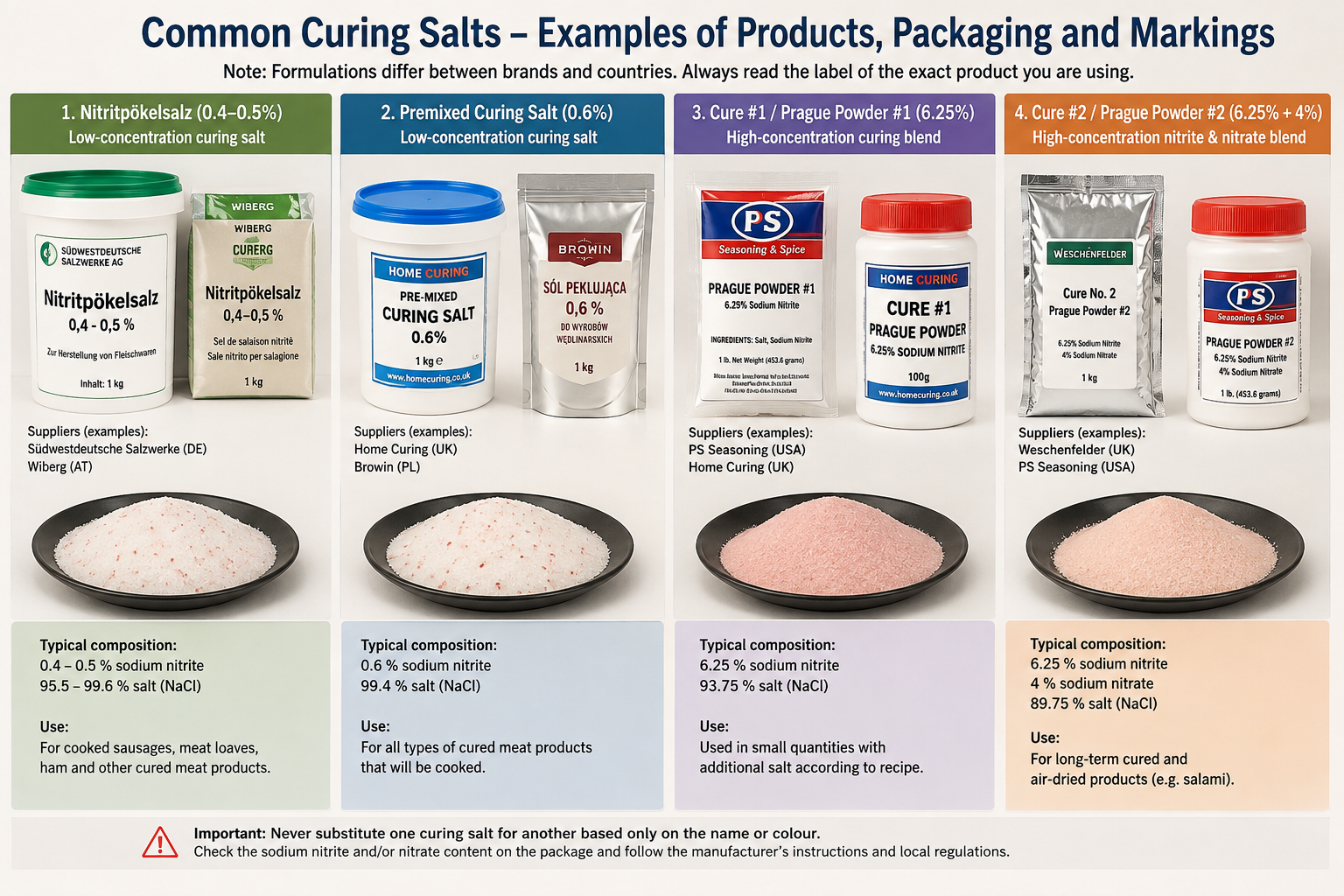
Example 1: German Nitritpökelsalz
The curing salt I commonly use is German-style Nitritpökelsalz.
My product contains approximately 0.4–0.5% sodium nitrite, with the remainder consisting primarily of ordinary salt.
This is a low-concentration premixed curing salt. In recipes designed specifically around this type of product, it can replace some or all of the ordinary salt specified by the formulation.
But even the name Nitritpökelsalz doesn't guarantee one concentration. Different versions are commercially available with different percentages of sodium nitrite.
So even if a recipe says "Pökelsalz", you should still read the label.
Example 2: A 0.6% Premixed Curing Salt
Other European curing salts may follow a similar principle but contain a slightly different nitrite concentration.
For example, a premixed curing salt containing 0.6% sodium nitrite is still predominantly ordinary salt, but it isn't chemically identical to my 0.4–0.5% Nitritpökelsalz.
The difference may appear small, but it illustrates why the actual concentration matters more than the generic product name.
Example 3: Cure #1 / Prague Powder #1
Now we reach a very different product.
A common formulation of Cure #1, also known as Prague Powder #1, contains approximately 6.25% sodium nitrite.
Compare that with Nitritpökelsalz containing approximately 0.5%.
Cure #1 therefore contains roughly twelve and a half times as much sodium nitrite per gram as a 0.5% Nitritpökelsalz.
It is a concentrated curing mixture and is used in much smaller quantities, with the remaining salt requirement supplied separately according to the formulation.
Cure #1 is not simply another name for Nitritpökelsalz.
Example 4: Cure #2 / Prague Powder #2
Cure #2 introduces another important difference.
A common formulation contains approximately 6.25% sodium nitrite plus 4% sodium nitrate.
The nitrate makes this a different curing system intended for products undergoing extended curing and maturation, where nitrate can provide a longer-term source from which nitrite is formed over time.
It is commonly associated with long-cured and dried products rather than ordinary cooked sausages.
Cure #2 therefore isn't a "stronger Cure #1". It is a different formulation intended for a different type of process.
Seeing the Difference in Numbers
Let's compare what would happen if we took exactly 20 g of several curing salts.
This is not a dosage recommendation. We're using 20 g only to demonstrate how dramatically the concentration can change.
| Example Product | Approx. Sodium Nitrite | Nitrite in 20 g Product |
|---|---|---|
| Nitritpökelsalz | 0.4% | 0.08 g |
| Nitritpökelsalz | 0.5% | 0.10 g |
| Premixed Curing Salt | 0.6% | 0.12 g |
| Cure #1 | 6.25% | 1.25 g |
Now the problem with gram-for-gram substitution becomes obvious.
Twenty grams of a 0.5% Nitritpökelsalz contains approximately 100 mg of sodium nitrite.
The same 20 g weight of a 6.25% Cure #1 contains approximately 1,250 mg.
That's 12.5 times as much sodium nitrite.
This is why curing salts must never be substituted based simply on their name or colour.
Premixed Curing Salt vs Concentrated Cure
It can help to think of the products as belonging to different systems.
Low-Concentration Premixed Curing Salt
Products such as German Nitritpökelsalz combine ordinary salt with a relatively small amount of sodium nitrite.
The curing agent has already been diluted throughout a much larger quantity of salt.
Concentrated Curing Blend
Cure #1 contains a much higher concentration of sodium nitrite and is consequently used in much smaller quantities. Ordinary salt is then handled separately according to the recipe.
Nitrite and Nitrate Cure
Cure #2 contains both nitrite and nitrate and is intended for specific longer curing processes.
These aren't three different brands of the same ingredient. They are different formulations.
Nitrite and Nitrate Are Not the Same Thing
The names sound similar, but sodium nitrite and sodium nitrate perform differently during curing.
Nitrite can participate directly in the curing reactions responsible for cured colour and flavour and contributes to microbial control.
Nitrate must first be converted to nitrite before participating in those reactions.
That conversion takes time and depends on conditions within the product, which is why nitrate has traditionally been associated with longer curing and maturation processes.
This is one reason you shouldn't replace Cure #1 with Cure #2—or Cure #2 with Cure #1—simply because both are curing salts.
Why Not Just Use Ordinary Salt?
Ordinary salt remains extremely important in sausage making, but it doesn't perform every function of nitrite.
Salt contributes flavour, reduces available water and assists protein extraction and binding.
Nitrite additionally contributes the characteristic cured colour and flavour and plays an important role in controlling certain microorganisms in appropriately designed cured products.
If a tested curing recipe specifies nitrite curing salt, simply leaving it out changes more than the colour of the sausage.
Why Are Some Curing Salts Coloured Pink?
Some concentrated curing salts are deliberately coloured so they're less likely to be confused with ordinary table salt.
But colour is not a reliable way to identify the composition or concentration of a curing product.
Different countries and manufacturers use different formulations and appearances.
Read the label. Don't identify curing salt by colour.
Always Check the Package
Before using a curing salt, look for the actual composition on the package or manufacturer's specification.
You need to know whether the product contains:
- sodium nitrite;
- sodium nitrate;
- both;
- and at what concentration.
Also check the manufacturer's recommended usage and whether the product is intended for the type of meat product you're making.
If the concentration isn't stated and you cannot obtain reliable information from the manufacturer or supplier, don't guess.
Follow the Product Instructions and Local Regulations
Curing agents are regulated food additives, and permitted amounts and applications can differ between countries and product types.
A recipe written for one curing system may therefore require adaptation when made somewhere else.
If you're using the exact curing product specified by a recipe, follow that recipe carefully.
If you're using a different curing product, follow the manufacturer's instructions and the food regulations applicable where you live rather than attempting a gram-for-gram substitution.
Use an Accurate Scale
Because concentrated curing salts can be required in very small quantities, accurate weighing is essential.
Don't measure concentrated curing products with an ordinary kitchen teaspoon.
Use a reliable digital scale with sufficient resolution for the quantity you're measuring.
For very small quantities, this may mean using a dedicated precision scale.
Keep Curing Salt Clearly Labelled
Curing products should remain in their original labelled packaging whenever possible.
If you transfer some to another container, label it clearly with the product name, nitrite/nitrate concentration and any other important information from the original package.
Never put curing salt into an unmarked container where somebody could mistake it for ordinary salt.
Don't Create Your Own Curing Mix by Guesswork
Once you understand the percentages, it may be tempting to start mixing concentrated curing agents and ordinary salt yourself.
That's not something I recommend for normal home sausage making.
Commercial premixed curing salts are produced to distribute the curing agent uniformly throughout the salt.
For the home sausage maker, using an appropriate commercially prepared curing product according to its instructions is the safer and simpler approach.
What You'll See in My Recipes
Whenever one of my recipes specifies a curing salt, I'll identify the type or concentration the recipe was developed around wherever this is important.
For example, if a recipe specifies:
Nitritpökelsalz (0.4–0.5% sodium nitrite)
that quantity applies to that type of low-concentration premixed curing salt.
It does not mean the same weight of Cure #1, Cure #2 or another curing product can be substituted.
If your curing product is different, stop and check its composition and manufacturer's instructions before continuing.
Know What You're Using
Curing salts aren't something to be frightened of, but they do need to be understood and measured correctly.
The most important rule is remarkably simple:
Never use a curing salt until you know exactly what product you have.
Check the nitrite and nitrate concentration. Follow the recipe when it specifies your product. Follow the manufacturer's directions and applicable local regulations when using another curing system.
And never assume that two products called "curing salt" are interchangeable.
Once you understand that distinction, curing-salt instructions become much easier—and much safer—to interpret.
Reference: Common Curing Salt Types
| Type | Typical Composition* | General Character |
|---|---|---|
| German Nitritpökelsalz | Example: 0.4–0.5% sodium nitrite | Low-concentration premixed salt and nitrite product. |
| European Premixed Curing Salt | Example: 0.6% sodium nitrite | Similar premixed concept, but concentration may differ. |
| Cure #1 / Prague Powder #1 | Common formulation: 6.25% sodium nitrite | Concentrated nitrite curing blend used in much smaller quantities. |
| Cure #2 / Prague Powder #2 | Common formulation: 6.25% sodium nitrite + 4% sodium nitrate | Nitrite/nitrate cure associated with long curing and drying processes. |
*These are examples, not universal specifications. Products and formulations vary by manufacturer and country. Always check the composition and usage instructions of the exact curing product you are using.
Important: Curing Salts Are Not Interchangeable
Never substitute Nitritpökelsalz, Cure #1, Cure #2 or another curing product gram-for-gram unless the recipe has specifically been formulated for that exact product and concentration. Check the sodium nitrite and/or nitrate content on the package and follow the manufacturer's instructions and applicable local food regulations. If you cannot identify the product or its concentration reliably, do not use it.