When people think about equipment for homemade sausage making, they usually imagine meat grinders, sausage stuffers and perhaps a smoker.
But some of the most useful tools in my kitchen are much smaller and considerably less expensive.
One of them is a simple electric coffee grinder.
Although these machines are primarily designed for grinding coffee beans, I regularly use mine to grind dry spices for my homemade sausages.
It's a small piece of equipment, but one that has become very useful when preparing my own seasoning mixtures.
The Coffee Grinder I Use
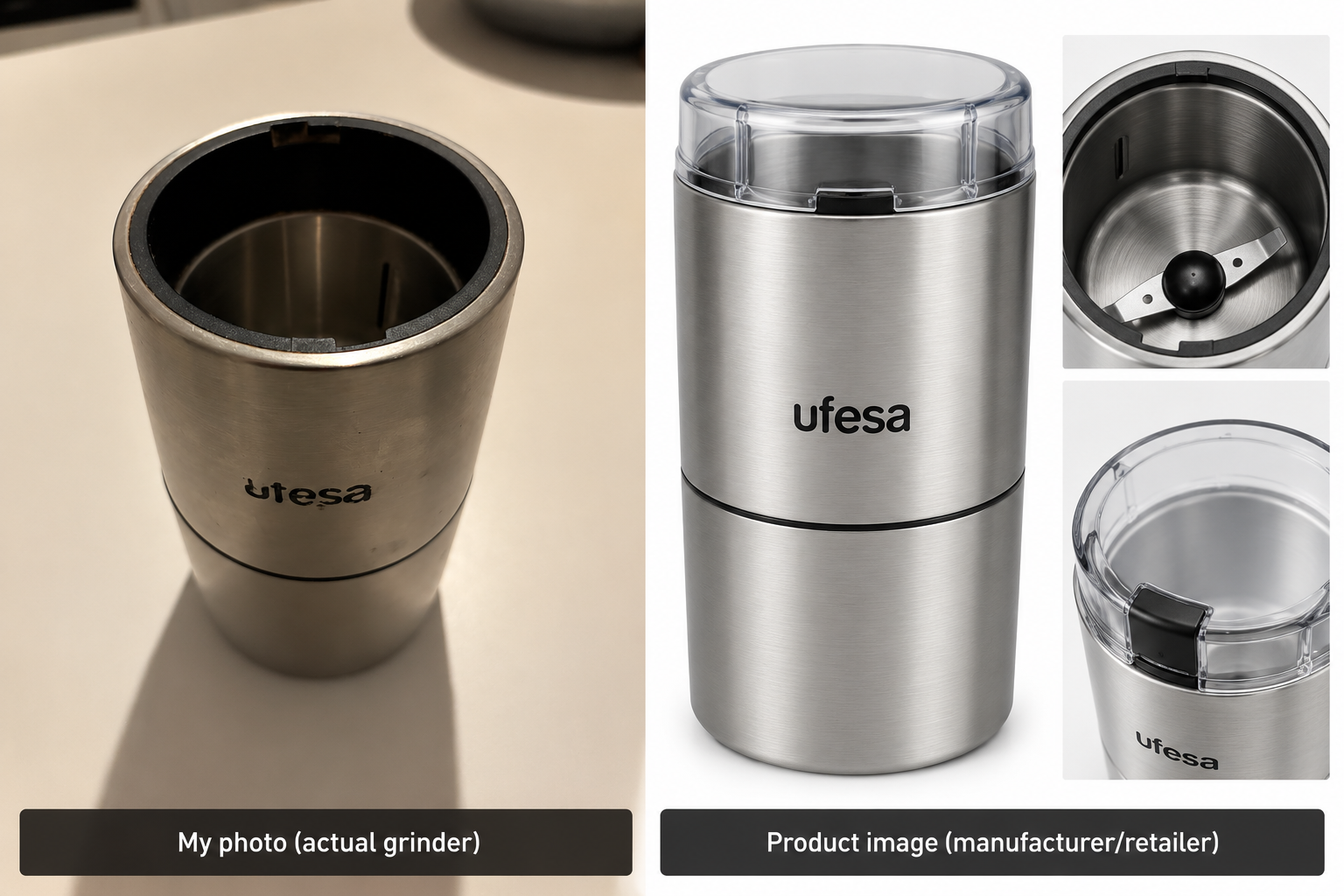
My grinder is a compact electric coffee grinder from Ufesa, with a stainless-steel exterior.
It's not a specialised sausage-making tool or a professional spice mill. It's simply a small household appliance that I use for preparing dry seasonings.
For the relatively small sausage batches I normally prepare at home, a compact grinder is often all I need.
Why Grind Your Own Spices?
Many sausage recipes use familiar spices such as black pepper, coriander, cumin, caraway, allspice and mustard seeds.
These are readily available in ground form, but whole spices often retain their aroma better during storage.
Grinding them shortly before use releases their aromatic compounds and gives us more control over the flavour of our sausages.
It also allows us to decide how finely or coarsely we want each spice ground.
For example, a coarse black pepper can give a cooked salami a different character from finely ground pepper, even when the quantity remains the same.
Which Spices Can Be Ground?
A small electric coffee grinder can be useful for many dry spices commonly found in sausage recipes.
- Black and white peppercorns: for freshly ground pepper in coarse or fine sausage mixtures.
- Coriander seeds: for bratwurst, salami and various international sausage recipes.
- Cumin seeds: particularly useful for spicy sausages such as Merguez.
- Caraway seeds: commonly found in Central European sausage preparations.
- Allspice berries: for traditional European charcuterie and liver sausages.
- Mustard seeds: for coarse seasoning mixtures.
- Dried chilli flakes: when a finer chilli seasoning is required.
The important point is that the ingredients should be dry and suitable for the particular grinder.
Very hard spices, large whole nutmegs or fibrous ingredients may not be appropriate for every model. Always follow the manufacturer's instructions.
Fine or Coarse Grinding?
One advantage of preparing your own spices is being able to control their texture.
For a fine bratwurst or emulsified sausage, we often want spices that are finely ground and evenly distributed throughout the mixture.
For a coarser sausage, such as our German Kochsalami, slightly coarser pepper and other spices can contribute to the characteristic appearance and flavour.
With a typical blade-style coffee grinder, short pulses can help control the result.
However, these grinders do not produce perfectly uniform particles. Some pieces may remain coarse while others become very fine.
For most everyday home sausage-making applications, that may be perfectly acceptable.
Grinding Small Quantities
One challenge when making sausages in small batches is that the amount of seasoning required can be surprisingly small.
A recipe for 1 kg of sausage might require only a gram or two of a particular spice.
Some coffee grinders struggle with extremely small quantities because the blades cannot catch the ingredients effectively.
In that situation, grinding a small combined batch of compatible dry spices can sometimes work better than grinding each ingredient separately.
However, always weigh the ingredients accurately before grinding and make sure the finished mixture is used in the intended proportions.
Keeping the Spices Cool
Electric grinders work quickly, but repeated or prolonged operation can generate heat.
Excessive heat may reduce some of the delicate aromas that make freshly ground spices attractive in the first place.
For this reason, I prefer the idea of using short grinding pulses rather than running the machine continuously for an unnecessarily long time.
Allow the grinder to rest when necessary and follow its recommended operating limits.
Cleaning Between Different Spices
One disadvantage of coffee grinders is that strong spice aromas can remain inside the grinding chamber.
Garlic powder, cumin, chilli and other strongly flavoured seasonings can leave noticeable traces.
That may not matter when preparing a similar spice mixture, but it can affect the flavour of the next batch.
Cleaning is therefore important, particularly when switching between very different seasonings.
Always disconnect the appliance before cleaning and follow the manufacturer's instructions.
Many electric coffee grinders have a fixed grinding chamber and should not be immersed in water.
A small dry brush or suitable cloth can help remove remaining spice particles, provided this is permitted by the appliance's instructions.
If you frequently grind spices, having a grinder dedicated to that purpose is often more practical than switching between coffee and strongly flavoured seasonings.
What Are the Limitations?
A small coffee grinder is useful, but it isn't a replacement for every type of spice-processing equipment.
Depending on the model, limitations may include:
- Difficulty grinding extremely small quantities evenly.
- Uneven particle sizes compared with specialised spice mills.
- Heat buildup during prolonged operation.
- Strong aromas remaining in the grinding chamber.
- Limited capacity for larger seasoning batches.
- Difficulty cleaning around fixed blades.
Most importantly, a dry coffee grinder should not automatically be used for wet ingredients, spice pastes or oily mixtures unless the manufacturer specifically permits this.
Is a Coffee Grinder Necessary for Sausage Making?
Absolutely not.
You can make excellent sausages using commercially ground spices, particularly if they are fresh and stored correctly.
A mortar and pestle is another useful alternative for preparing small quantities of whole spices.
But if you enjoy experimenting with different seasonings and prefer grinding spices shortly before use, a compact electric grinder can be a worthwhile addition to your kitchen.
It is also an example of how ordinary household equipment can serve more than one purpose in homemade sausage making.
My Conclusion
I started Dieter's Sausage Kitchen with the idea that good homemade sausages shouldn't require expensive professional equipment.
A small electric coffee grinder fits that philosophy perfectly.
It's not an essential purchase, and it doesn't replace careful measuring or an understanding of seasoning.
But for preparing freshly ground dry spices in small batches, it can be a convenient and practical tool.
Sometimes the most useful sausage-making equipment is something that was never originally designed for making sausages at all.
Dieter's Tip: If you already own an electric coffee grinder, check whether its manufacturer allows dry spice grinding before buying a separate spice mill. For small sausage batches, freshly grinding whole peppercorns, coriander or cumin shortly before mixing can make a noticeable difference to the aroma of your seasoning.